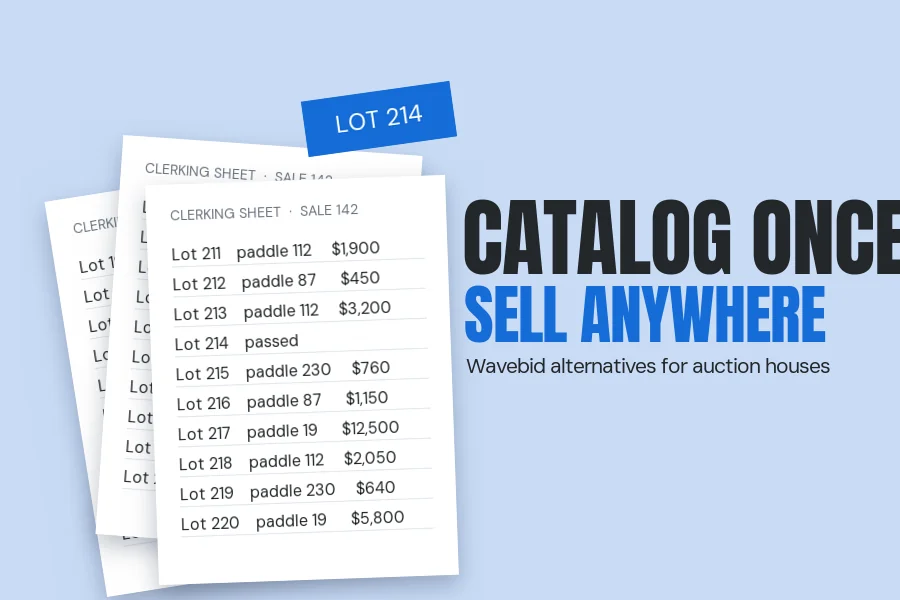
Wavebid is the back office behind a large share of the auctions on Proxibid: the browser-based system where the catalog is built, the sale is clerked, the invoices go out and the consignors get paid. Since January 2019 it has belonged to Proxibid, and since February 2020 both have belonged to Auction Technology Group (ATG), the company that also owns LiveAuctioneers, BidSpotter and the-saleroom. That ownership used to be a footnote. In June 2026 it stopped being one, when Wavebid told its users that “certain third-party integrations will be winding down” to make room for deeper ties to “ATG’s marketplaces and white label solution”.
This guide is for auction houses that run, or are being offered, Wavebid and want to know what it costs, what the wind-down means in practice, and what the alternatives are. We build one of those alternatives, so read the Circuit section with that in mind. Every claim about Wavebid comes from its own help centre, its website or ATG’s published rate cards, listed at the end, and was checked on October 20, 2026.
What Wavebid Is, and Who Owns It
Wavebid was founded in Minneapolis in 2011 by Russ Hilk and Michael Long as a cloud alternative to the desktop auction software of the day. It describes itself as “a comprehensive, cloud-based auction management solution, designed by auctioneers, for auctioneers”, with cataloging and accounting as its strongest features. Proxibid, which had worked with Wavebid since 2011, bought it in January 2019 and made it the seller-side half of its “Powered by Proxibid” offer. In February 2020 TA Associates bought Proxibid and ATG together and put Proxibid under ATG, so Wavebid is now one of the ten or so brands we covered in who owns the auction marketplaces. Support is still run from Minnesota, and the terms of use put any dispute in Hennepin County.
What the product does, from its own help centre:
- Cataloging. A Lot Builder with fill-in-the-blank templates, HTML descriptions, drag-and-drop lot sequencing, a missing-lot report, a VIN lookup for vehicles, video and PDF attachments, bulk photo management and a mobile Item Capture app.
- Clerking. A clerking screen with multiple rings, an auctioneer screen, Auction Tube, driver’s licence scanning at check-in and printed clerking sheets.
- Accounting and invoicing. Tax codes by bidder location, buyer’s premiums and fees at company and auction level, invoices generated as lots are clerked, emailed with a Pay Now button through PayTrace, Authorize.net, Payflow or PlugNPay, and bulk payment application.
- Sellers. Seller contracts, seller inventory, commissions and settlement statements.
- Marketing. Email templates, customer segments, a buyer’s guide generator, an electronic poster, and listing pushes to AuctionZip, EstateSales.NET, GoToAuction, Facebook, Twitter and Craigslist.
- Website. A WordPress plugin, called Auction Services or Ignite, that syndicates the auction calendar and catalog pages to the auction house’s own site.
- Bidding platforms. Linked exports to Proxibid and BidSpotter, including dual listing a live sale on both, plus SAM (MarkNet), Invaluable/AuctionZip and Maxanet. LiveAuctioneers is handled by a manual CSV export and a manual post-sale import that needs the spreadsheet reformatted first.
Two things are not on that list. There is no AI cataloging: no drafting of descriptions or estimates from photos. And there is no collector CRM in the sense we use it in our AuctionFlex alternatives guide: customer records are keyed to paddle numbers and seller codes, with segments for email, rather than a history of which collector bid on which lots, who was the underbidder and when they last opened your email.
What Wavebid Costs in 2026
Wavebid does not publish a price list. Its pricing page redirects to the login screen. The only published figures are on the Proxibid 2026 master rate card, which has a Wavebid section:
| Item | Wavebid (Proxibid 2026 rate card) |
|---|---|
| Monthly pricing | “Now available on a limited basis. Pricing varies by customer, please contact your Client Success Manager for details.” |
| Webinar training | Free, unlimited |
| One-on-one training | $150 per hour |
| Data migration | From $1,000, depending on volume |
Software directories such as Capterra list Wavebid at about $99 per user per month, a figure we could not verify against anything Wavebid publishes, so treat it as an indication of the order of magnitude rather than a quote. Remember also that Wavebid is the back office only. Online bidding is a separate bill, and for most Wavebid users that bill is Proxibid’s: 5% of hammer in arts, antiques and firearms, plus event fees, plus the premium charged to your buyers. We went through that rate card line by line in Proxibid alternatives and fees.
“Available on a limited basis” is worth pausing on. It is unusual wording for a product a company wants to sell, and it fits the June announcement: Wavebid is being folded into ATG’s seller tools rather than marketed as a standalone back office.
The June 2026 Announcement, and What It Means
On June 18, 2026, Wavebid published an “Announcement for BidWrangler Wavebid Users” in its help centre. The substance:
- Wavebid and ATG are “making deeper technological investments” in integrations with ATG’s marketplaces (Proxibid, LiveAuctioneers, BidSpotter) and ATG’s white label solution.
- “In order to make way for these enhancements, certain third-party integrations will be winding down.”
- Users with a direct relationship with ATG keep access with no disruption. Users who bought Wavebid through a reseller, which is how BidWrangler customers got it, “are free to switch to a direct relationship with Auction Technology Group”.
- Current users who also use ATG marketplaces keep uninterrupted access “whether or not you use other bidding solutions in addition to ATG marketplaces”.
Read plainly: the back office is being tied to the marketplace. If you clerk in Wavebid and sell on Proxibid, nothing changes. If you clerk in Wavebid and sell somewhere ATG does not own, the integration that made that possible is the thing being wound down, and the offered fix is to become an ATG customer directly. Two months later, on August 21, 2026, a second notice told every user of the WordPress plugin to change its syndication address by September 26 or their website would stop updating. Neither notice is sinister on its own. Together they describe a product whose roadmap is set by its owner’s marketplaces, which is precisely the position we warned about in who owns the auction marketplaces.
Why Auction Houses Look for a Wavebid Alternative
The marketplace chooses the back office, and now the back office chooses the marketplace. The integrations being wound down are the ones that let a Wavebid catalog go somewhere other than ATG. HiBid, the busiest general marketplace in North America, has never been on Wavebid’s integrated list at all. If you want the freedom to list a sale wherever the bidders are, your cataloging system cannot belong to one of the marketplaces.
No AI cataloging. Wavebid’s templates and HTML editor were state of the art in 2015. In 2026 an auction house cataloging 800 lots a month expects descriptions and estimates drafted from photographs and checked by a specialist, not typed. See AuctionWriter alternatives for what that looks like inside a platform.
Customer records, not a CRM. Wavebid can build a customer list and segment it for email. It cannot tell you that the underbidder on lot 212 in March is the same collector who bought three Morgan dollars last year and has opened every email since, which is the information that sells the next consignment.
Opaque pricing. “Varies by customer” means your neighbour may be paying a different rate for the same software, and the number can change when your Client Success Manager’s targets do. An auction house planning three years out needs a price it can write down.
Manual work where there should be an integration. The LiveAuctioneers path, updated in May 2026, is a CSV export, a manual upload, then a post-sale spreadsheet that must have its currency formatting and leading zeros removed by hand before Wavebid will import it. That is a 2026 help article describing a 2012 workflow, and LiveAuctioneers is a sister company.
If you clerk general estate and equipment sales on Proxibid and none of this bothers you, stay. Wavebid’s invoicing and settlement are solid and its data export is better than most. If two or more of these describe you, read on.
Two Kinds of Alternative
Another back office that still feeds marketplaces. This keeps your sales where they are and changes the software you catalog and clerk in. It is the right move if the bidders really do come from browsing and your complaint is only the tool.
A platform that runs the sale on your own website. Cataloging, clerking, bidding, invoicing, settlement and CRM in one system on your domain, with marketplaces as an optional feed rather than the host. It is the right move if you have a specialty, a name collectors recognise and a client list you would like to own. Most auction houses that have been trading for a few years are in this group whether they have noticed or not.
Many end up with both: the sale runs on their own platform, and selected lots or whole catalogs are also listed on a marketplace for reach, with the marketplace’s share measured sale by sale.
Alternatives That Run the Whole Auction House on Your Own Website
Circuit Auction AI
Circuit replaces Wavebid and the bidding platform together. It installs as a WordPress auction plugin on the site you already own and covers consignment intake, AI cataloging that drafts descriptions and estimates from photos, timed auctions with staggered closing and bid extensions, live auctions with a clerk console and real-time online bidding, absentee and phone bids, a built-in auction house CRM with email tracking, invoicing, consignor settlement, shipping, multi-currency and 40+ languages. Bidders register with you, on your domain, and never see a marketplace logo.
Circuit is built for auction houses selling collectibles: coins, stamps, fine art, antiques, cards, watches, books, sports memorabilia, militaria and firearms, where it also manages bidder and dealer FFLs. It is not for vehicles, farm equipment or real estate, which is to say it is not for the categories Proxibid serves best. Pricing is published: a subscription with a small commission on the Standard plan, or a fixed-price Enterprise plan with no commission at all. Data migration from Wavebid’s CSV and ZIP exports is part of onboarding.
Bidsquare Cloud
The white label product of the Bidsquare marketplace, with AI cataloging, a clerking console, invoicing and the option to co-list to Bidsquare. Priced on request by events per year. A good middle path for fine art and antiques auction houses that want their own site and a curated marketplace feed from the same vendor. Full table: Circuit vs Bidsquare Cloud.
Bidpath
Auction management with own-branded online bidding, used by auction houses in the US and UK. Worth a look for a general auction house that wants back office and bidding from one vendor without a marketplace in between.
Alternatives That Are Back Offices and Still Feed Marketplaces
Auction Flex 360
Sandhills Global’s cloud successor to the AuctionFlex desktop, priced at $95 to $295 a month on a published page, and the natural pairing with HiBid at 2% of hammer. If your reason for leaving Wavebid is that you want to sell on HiBid rather than Proxibid, this is the shortest move. If the reason is the CRM or AI cataloging, it is the same category of tool as Wavebid, from a different marketplace owner. See HiBid alternatives for the full rate card and AuctionFlex alternatives for where the model runs out.
AuctionWriter
Not a back office, but worth naming here because it fixes Wavebid’s biggest gap. AuctionWriter drafts lot descriptions with AI and exports them to a list of bidding platforms. Pairing it with Wavebid gives you AI cataloging today at the cost of a second subscription and a second place your catalog lives. See AuctionWriter alternatives.
Bidding Platforms That Still Need a Back Office
These replace the Proxibid side of a Wavebid-plus-Proxibid setup, not the Wavebid side. If you choose one, you still need somewhere to catalog, clerk and settle.
- BidJS (Bidlogix). A bidding engine that embeds in your site at a fixed monthly fee with no commission. Strong on timed and webcast bidding; cataloging, settlement and CRM are outside its scope. Circuit vs BidJS.
- Auction Mobility. Branded bidding sites and apps, owned by ATG since 2020, which is the “white label solution” the June announcement refers to. Cataloging, settlement and CRM are not part of the offer. Circuit vs Auction Mobility.
- BidWrangler. Branded online bidding popular with estate and general auctioneers, and the platform named in Wavebid’s wind-down notice. BidWrangler customers who got Wavebid through it are the ones being asked to move to a direct ATG relationship.
What It Actually Costs: A Worked Example
Wavebid’s price is unpublished, so the table carries it as a line item rather than a number. The other figures are from the October 2026 rate cards and were worked through in the HiBid and Proxibid guides; re-run them with your own hammer on our marketplace fee comparison page. Assume an auction house with $1,200,000 of online hammer a year across 40 sales, half of them webcast, in arts, antiques or collectibles.
| Wavebid + Proxibid (Bronze) | Auction Flex 360 + HiBid | Circuit Standard | Circuit Enterprise | |
|---|---|---|---|---|
| Commission on online hammer | 5% = $60,000 | 2% = $24,000 | 2% = $24,000 | None |
| Event and per-bid fees | 20 live at $675 plus $200 per-lot fee = $17,500, 20 timed at $275 = $5,500 | Up to $150 per sale, say $5,000, plus $1,500 webcast setup | None | None |
| Back-office software | Wavebid, “varies by customer” | $1,140 to $3,540 per year | Included | Included |
| Training and migration | $150 per hour, migration from $1,000 | Not stated | Included | Included |
| Buyer-side marketplace fee | Proxibid Premium, passed on by most auction houses | None | None | None |
| Approximate annual cost | $83,000 plus Wavebid | $31,000 to $34,000 | $27,000 | Fixed |
The honest reading: the back office is not where the money goes. Wavebid’s own fee, whatever it turns out to be, is small next to the 5% and the event fees of the marketplace it is tied to. The cost of Wavebid is Proxibid. An auction house that moves its cataloging and clerking to a platform that also runs bidding on its own domain cuts the bill by roughly two thirds on this example, and the bidders it registers there are its own.
How to Move Off Wavebid Without Losing a Sale
Wavebid documents its data exports properly, which makes this easier than leaving most marketplaces. Do it in this order.
- Download everything first. From each auction: the catalog CSV and the photo ZIP from Auction > Export Auction, or the Auction Vault for sales older than 90 days. From the company: the full buyer and seller customer lists from Customers > Lists, using the Download button rather than Export, which stops at 2,000 rows. Then seller settlements, invoices and the payment reports. Do this before you tell anyone you are leaving.
- Rebuild the collector history. Wavebid’s customer list gives you names and paddle numbers; it does not give you what each paddle bid on. Your clerking sheets, absentee bid records and Proxibid’s winning-bidder reports do. Tag every name by category before importing it into the new CRM.
- Set up the new platform before announcing anything. Registration, a test sale, the invoice flow and consignor statements should all work before the first bidder arrives. Our bidder confidence checklist is the test script.
- Run one sale in both places. Keep the Proxibid listing for the sale, clerk it in the new system, and run the same catalog on your own site with a reason to register directly, such as a lower buyer’s premium.
- Email every past buyer and every consignor from the auction house, not from the platform, explaining where future sales run and why it is better for them.
- Measure the marketplace’s share after three sales. Keep listing on Proxibid if its share of hammer justifies 5% and the event fees. Drop it if the bidders turned out to be yours all along.
Making the Decision
Stay on Wavebid if you sell equipment, vehicles or general estates on Proxibid, your bidders come from browsing, and you are comfortable being an ATG customer on both sides of the sale. Its clerking and invoicing are mature and it will give you your data if you ever change your mind.
Move if you want to list where the bidders are rather than where your software allows, if you catalog enough lots that AI drafting is a cost line rather than a novelty, if you need a CRM that knows your collectors, or if “pricing varies by customer” is not a sentence you can put in a budget. For an auction house in that position, a platform on your own domain replaces Wavebid and the marketplace together, at a fraction of the combined bill.
About Circuit Auction
Circuit Auction is an all-in-one auction management platform for professional auction houses specializing in collectibles. It runs on your own website under your own brand, with AI cataloging, live and timed bidding, a built-in CRM, automated invoicing and consignor settlement in one system.
Thinking about moving off Wavebid? Book a demo and we will walk through the migration plan above with your own sale calendar and your Wavebid exports.
Sources (checked October 20, 2026): Wavebid: Announcement for BidWrangler Wavebid Users, June 18, 2026, Wavebid: Auction Services (Ignite) syndication server change, August 21, 2026, Wavebid: Welcome to Wavebid, Wavebid: Integrated Bidding Platforms, Wavebid: LiveAuctioneers, May 29, 2026, Wavebid: Downloading Auction Data from Wavebid, Wavebid: How Can My Bidders Pay Online, October 1, 2026, Wavebid Terms & Conditions, Wavebid accounting and cataloging tools, Wavebid marketing tools, Proxibid master rate card 2026, Proxibid acquires Wavebid, January 2019, TA Associates on the ATG and Proxibid acquisitions, February 2020, Wavebid on Capterra, AuctionFlex 360 pricing.