
The work of running an auction house has grown far more complex in the past decade. Consignments arrive faster. Bidders expect instant online access. Compliance requirements expand every year. Settlement needs to happen within days, not weeks.
The technology behind most auction houses has not kept pace.
We see it consistently at Circuit Auction: auction houses that handle cataloging and bidding reasonably well, but leave settlement, marketing, compliance, and analytics to spreadsheets, separate tools, or someone’s memory. Every manual handoff between disconnected systems creates friction. Multiply that across hundreds of lots and dozens of sales per year, and the cost in time, errors, and missed opportunities becomes significant.
This guide maps every component of what complete auction management software for collectibles looks like in 2026. Whether you run a numismatic auction house, a philatelic firm, a sports card operation, or a fine art gallery, this is the reference for evaluating your current setup or choosing your next platform.
Circuit Auction has been building auction technology since 1995, starting with what became the first website to sell stamps online. Thirty years across four continents shaped everything in this guide.
Why Auction Houses Are Replacing Fragmented Systems
Most auction houses today operate on a patchwork of tools. One system for cataloging. Another for live bidding. A spreadsheet for invoicing. An email platform for marketing. A filing cabinet for consignor agreements.
Each tool does its job in isolation. But the gaps between them are where problems live. Data gets retyped. Commission terms get misread. Bidder records exist in three places with three different versions. Staff spend hours every week on work that adds no value to the business.
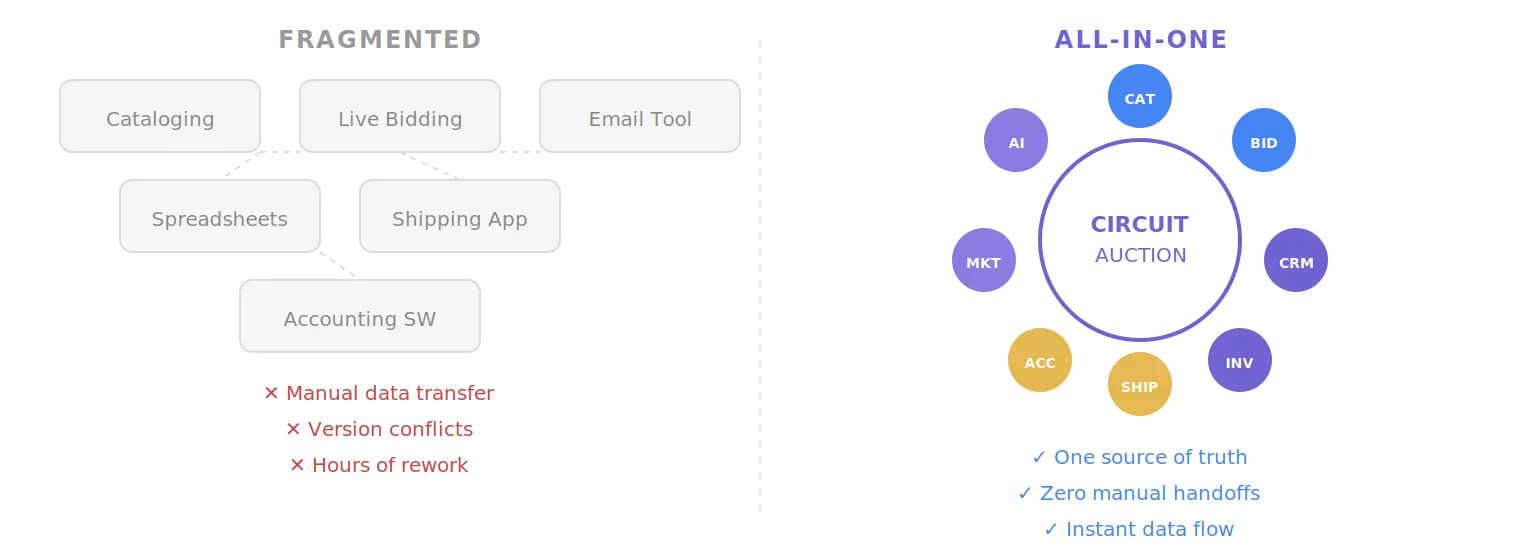
An all-in-one auction management platform eliminates these gaps. One system handles every stage of the auction lifecycle: intake, cataloging, marketing, bidding, invoicing, payment, shipping, settlement, and analytics. No data transfers between tools. No reconciliation. No version conflicts.

The result is fewer errors, faster operations, and a team that spends its time on work that actually grows the business: sourcing consignments, building relationships, and running better sales.
Book Your Free 15-Minute Demo — See how Circuit Auction replaces your entire software stack in one platform.
Data Ownership: The Most Important Decision You Will Make
Before evaluating features, every auction house needs to answer one question: who owns the data?
Your bidder list and bid history are the most valuable assets your auction house owns. More valuable than any single lot. They represent years of relationships, purchasing patterns, and trust.
A platform that hosts your auctions on a shared marketplace is borrowing your data while lending you their traffic. Your buyers sit next to your competitors’ buyers. Your hard-earned relationships become someone else’s cross-selling opportunity. When you leave, your bidder data may not come with you.
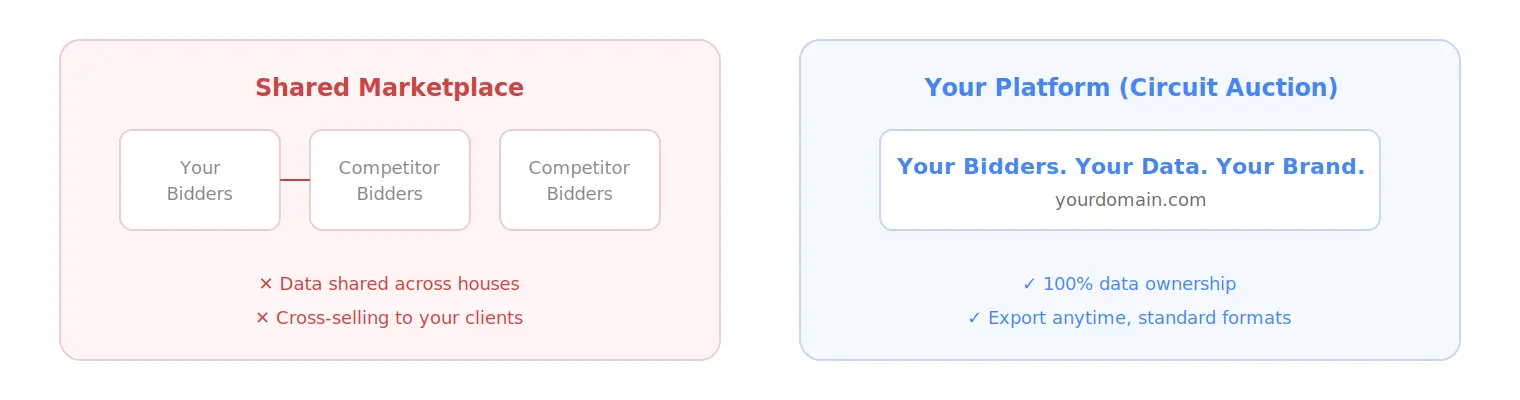
Circuit Auction’s white-label auction house platform operates on a fundamentally different model. Your auction runs on your domain, under your brand, with your design language. Bidders see your auction house, not a software company. Your bidder records, lot history, images, and transaction data belong entirely to you. You can export everything in standard formats at any time.
This is not a preference. For any serious auction house, it is a business requirement.
White-Label Auction Software: Your Brand, Your Domain
Circuit Auction provides fully white-label auction websites. Your bidders see your logo, your colors, your domain name. The technology is invisible. The experience is entirely yours.
This matters for trust. A collector spending $50,000 on a rare coin wants to feel they are dealing with an established auction house, not a marketplace that hosts hundreds of sellers. White-label branding communicates professionalism and permanence.
Circuit also builds and hosts your auction website with full SEO optimization, or installs as a WordPress auction plugin on the site you already have. Every lot page is structured with proper metadata and indexable content, turning your catalog into a marketing channel that attracts new bidders through Google around the clock.
AI-Powered Auction Cataloging: From Days to Hours
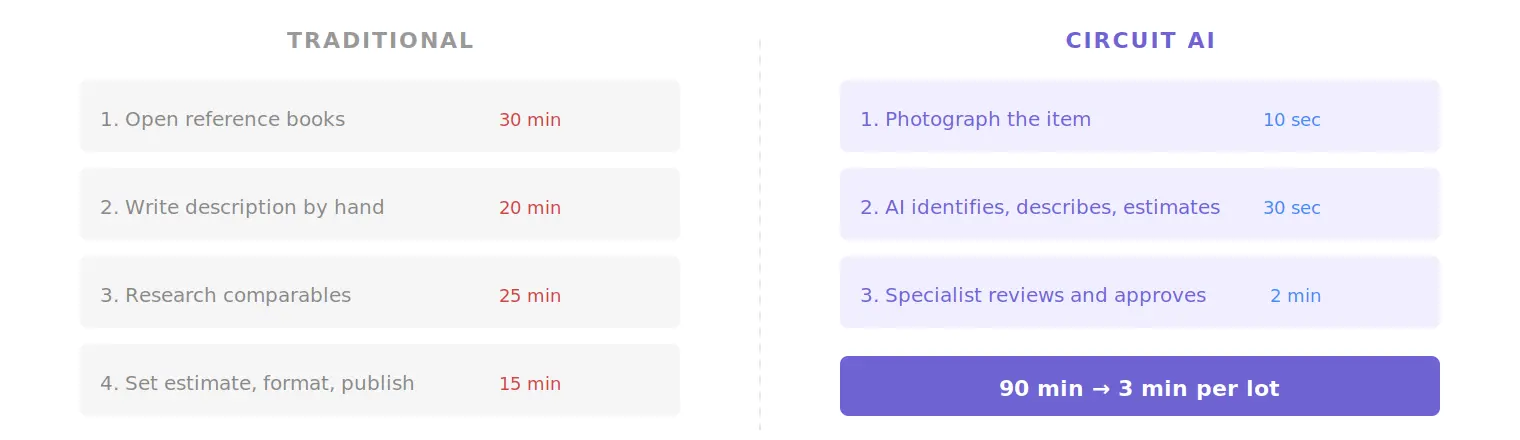
Cataloging is the single largest operational bottleneck for most collectibles auction houses. A consignor delivers 200 coins. A specialist opens reference books, writes descriptions by hand, researches comparables individually, debates estimates over email. The process takes days.
Circuit Auction’s AI cataloging works differently. It is agentic AI, meaning it does not wait for instructions at each step. You photograph the item. The system identifies it using visual recognition, drafts a description based on market data and auction records, suggests a price range, and maintains your editorial voice across every listing.
Your specialist reviews and approves rather than writing from scratch. Eight hundred lots read as if one expert wrote them all. No fatigue. No drift between catalogers. No inconsistency between Tuesday’s descriptions and Friday’s.
AI Cataloging Across Collectibles Verticals

Circuit Auction provides specialized cataloging tools tailored to each collectibles category. Each vertical has its own dedicated module with category-specific fields, grading integrations, and terminology.
Coins and numismatics: AI identifies the coin type, date, mint mark, and suggests a grade range. PCGS and NGC certification numbers integrate directly into lot records. Market data from recent auction results informs the estimate.
Stamps and philately: The system recognizes stamp issues, suggests Scott or Stanley Gibbons catalog numbers, and drafts descriptions including perforation, watermark, and condition details.
Sports cards: AI identifies the player, year, set, and variant. PSA, BGS, SGC, and CGC grades display prominently. Population data informs pricing. Full support for baseball cards and all major sports.
Fine art: Visual recognition assists with artist identification, medium, dimensions, and period. Provenance fields, exhibition history, and condition reporting integrate into the catalog record.
Antiques and estate items: Flexible custom fields accommodate diverse inventory. Period classification, maker attribution, and batch processing handle high-volume estate consignments efficiently.
Rare books and manuscripts: Edition tracking, binding documentation, bibliographic data, and collation tools designed for serious book dealers.
Watches and jewelry: Certification tracking, movement documentation, GIA gemological integration, and appraisal tools for luxury timepiece and jewelry dealers.
Sports memorabilia: Authentication certificates, game-used verification, player and team databases, and era classification across all major sports.
Musical instruments: Serial number tracking, manufacturer databases for Steinway, Gibson, Martin, and others, plus specialized condition assessment for playability and restoration.
Militaria: Authentication certificates, period classification from Civil War through modern conflicts, unit tracking, and chain of custody documentation.
Vintage posters: Size tracking, printing technique documentation, restoration history, and style classification from Art Nouveau through Mid-Century Modern.
Circuit also supports dedicated modules for postcards, autographs and documents, wine and spirits, comic books, toys and action figures, photography and cameras, and firearms, each with category-specific features, terminology, and compliance tools.
Image Management
A collectibles auction house produces hundreds of photographs per sale. Each image needs to reach the correct lot. Circuit Auction’s bulk upload with automatic lot matching eliminates the manual sorting that otherwise absorbs hours of staff time. High-resolution archival storage ensures images are always available for future reference, reprints, or marketing.
Custom Workflows: The Platform Adapts to Your Process
Every auction house follows its own workflow. Some require dual approval before a lot goes live. Others need authentication sign-off above a certain value. Some run approval chains that involve three departments.
Circuit Auction adapts to your process. Not the reverse. You configure the workflow rules that match how your team actually operates. A system that imposes a fixed workflow creates daily friction that compounds across every sale.
Consignor Term Management
Every consignor comes with different terms: flat rates, tiered commissions, split arrangements between heirs. These terms must travel with the lot from intake through settlement automatically. If anyone on your team re-enters commission figures at payout, errors will follow.
In Circuit Auction, consignor agreements are recorded once and applied automatically through every stage of the lot journey. Settlement calculations are exact every time.
Revision Control and Chain of Custody
Revision control tracks who changed what and when on every lot record. Reserve prices, condition notes, descriptions: every edit carries a complete audit trail. This matters for internal accountability, insurance claims, and consignor transparency.
Barcode scanning tracks each item from intake through photography, the auction floor, and shipping. At any moment, you know exactly where every consignor’s property is.
Batch Operations
Adjusting reserves across 200 lots, applying grades to a series, reassigning unsold items to the next sale: these operations require minutes in Circuit Auction rather than an afternoon of manual updates. Every hour saved on repetitive data entry is an hour your specialist can spend calling a consignor or preparing the next sale.
Bidder Engagement: CRM, Multi-Language, and SEO
Auction CRM That Tracks Collecting Behavior
A CRM built for auctions tracks more than contact details. Circuit Auction’s CRM records which categories each bidder follows, what price ranges they are active in, which lots they watch, and how their interests shift over time.
When a significant consignment arrives, the system identifies every registered bidder with relevant history and sends a targeted alert. Not a mass email to the full database. A precise message to the people who actually want that material. This is the difference between a quiet auction and a competitive one.
Multi-Language Support for Global Bidders
Your team works in English. Your leading client in Munich reads German. Your growing base in Tokyo needs Japanese. In specialized collectibles, serious buyers exist worldwide.
Circuit Auction supports multi-language catalogs, bidding interfaces, and automated communications. Bidders participate in their own language. This directly affects whether international collectors engage with your sales or look elsewhere.
Watchlists and Outbid Alerts
Every notification pulls a bidder back into active competition during the critical hours before the gavel drops. Circuit Auction’s automated watchlist alerts and outbid notifications keep bidders engaged without requiring any manual effort from your team.
SEO-Optimized Lot Pages
Every lot page on a Circuit Auction website is a potential search result. A collector in Osaka searching “1856 British Guiana postal history” should find your auction through Google, not only through your mailing list.
Circuit builds lot pages with proper metadata, clean URLs, and indexable content. Your catalog becomes a marketing engine that attracts new bidders 24 hours a day without advertising spend. Auction houses investing in SEO-optimized lot pages are growing their bidder base steadily. Auction houses that are not are paying more each year for the same reach.
Zero-Latency Live Bidding: Why Speed Is the Most Important Feature
This is where the platform proves itself. Or fails.
When a bidder in Singapore places a bid, the response must be immediate. Not fast. Immediate. In a sale where lots move at thousands or millions of dollars, half a second of visible delay raises doubt. The auctioneer loses rhythm. Phone bidders drop. Online participants hesitate. One bad experience and that bidder does not return.
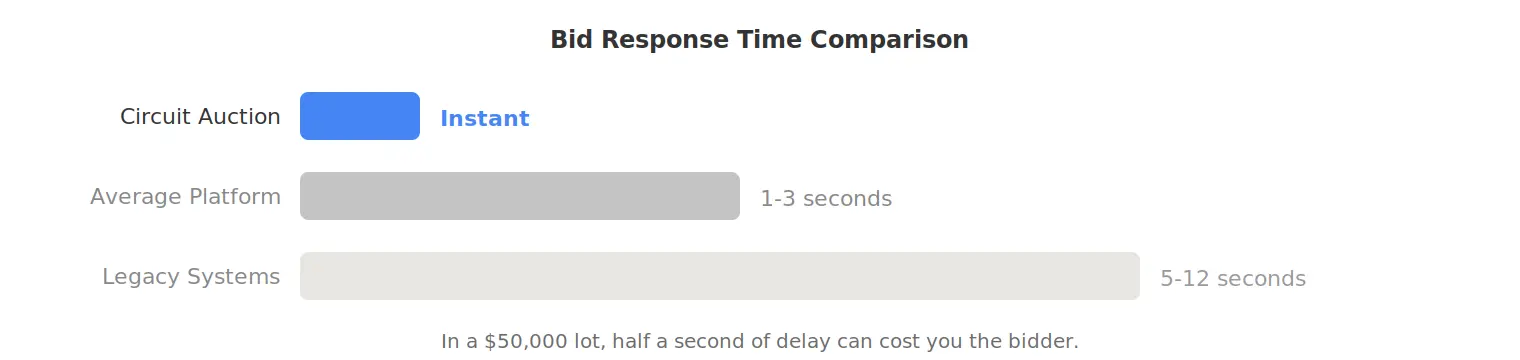
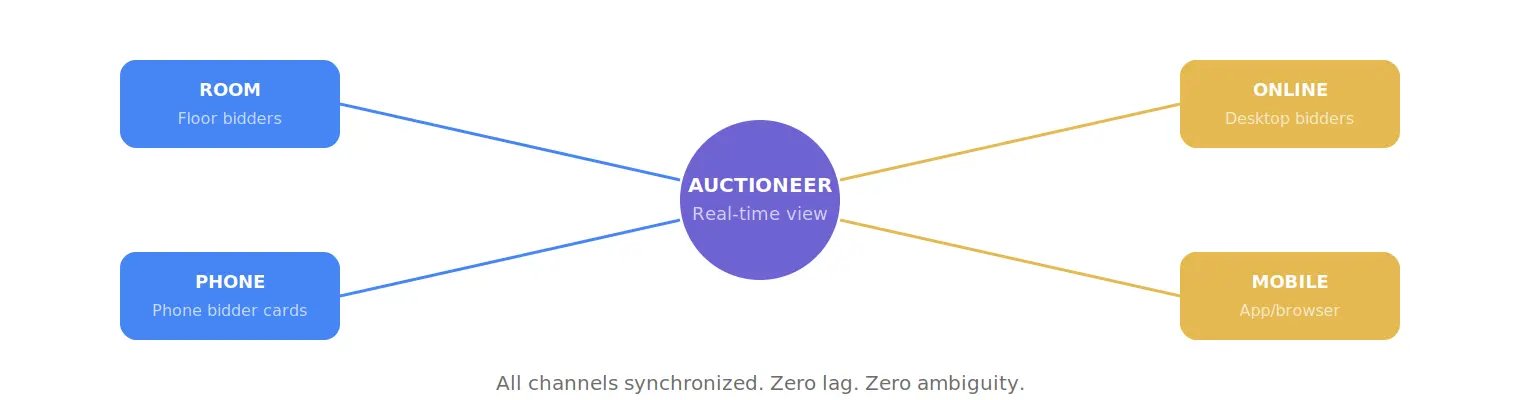
Circuit Auction is the fastest auction management platform available today. The live bidding engine synchronizes every channel in real time: room, phone, online, mobile. The auctioneer sees all bids the instant they arrive. No lag. No sequence errors. No ambiguity about who bid first.
Platform Speed Beyond the Live Sale
Speed extends beyond the auction event. How quickly does your catalog load on a mobile device? How responsive is your site with 400 simultaneous users browsing? How fast does a search return results?
A bidder encountering your auction house for the first time judges your professionalism by your platform’s performance before they ever evaluate your expertise. They cannot see your back office. They can see how fast your site loads. Circuit Auction’s infrastructure is built for speed at every touchpoint, not just during the live sale.
Multi-Channel Bidding
Circuit Auction synchronizes advance bids, room bids, phone bids, online bids, and mobile bids into a single real-time view. Phone bidder cards with client details and color-coded status keep high-value sales organized. Import tools for bids submitted by email or fax keep established clients comfortable.
Multi-channel publishing means you catalog each lot once. It appears on your own website and any external platforms you choose, all managed from a single dashboard. Currency conversion for international invoicing removes friction that discourages cross-border participation.
Book Your Free 15-Minute Demo — See the fastest auction platform in action.
Private Sales and Flexible Selling Models
Not everything goes to auction. Some items require discretion. Some consignors prefer a guaranteed sale. Some buyers want to acquire without competing publicly.
Circuit Auction includes a private treaty module for direct sales, quiet offers behind the scenes, and buy-now options for selected lots. All managed within the same system with the same controls, the same CRM data, and the same reporting.
Auction houses that limit themselves to the public auction format are leaving revenue on the table. Flexibility in how you sell is as important as what you sell.
Settlement, Accounting, and Shipping: Where Profit Is Won or Lost
This is where most auction houses lose time and revenue without realizing it.
Automated Invoicing
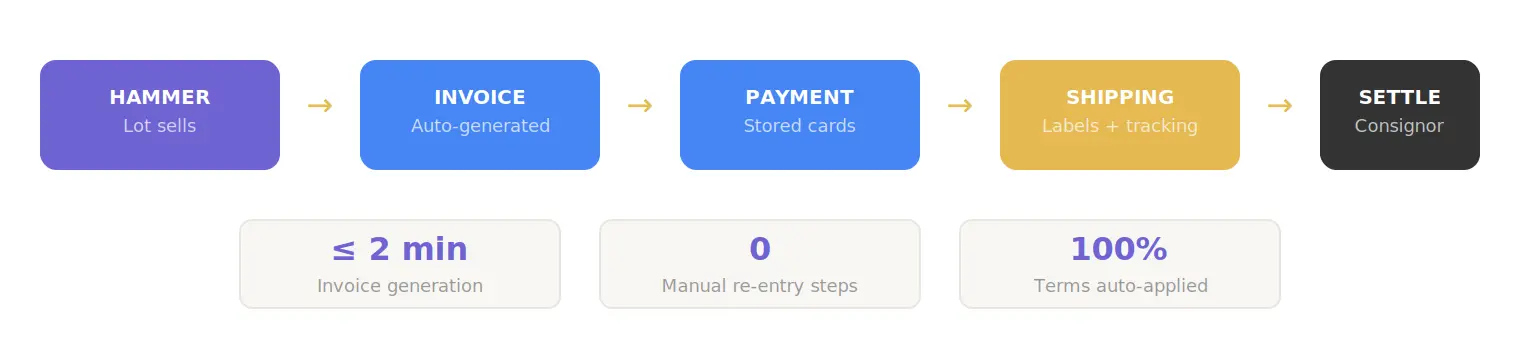
The moment a lot sells, the invoice should be complete. Premiums calculated. Taxes applied. Shipping estimated. Consolidated for buyers who won multiple lots. Delivered within minutes, not assembled by hand the following day.
Circuit Auction’s automated invoicing and settlement tools generate the invoice at the fall of the hammer. Buyer’s premium tiers, sales tax by jurisdiction, and VAT (including Margin Scheme for UK/EU) are all calculated without manual input.
Commission Management and Consignor Settlement
Each consignor’s original terms flow directly from their agreement into the settlement calculation. No spreadsheets. No manual recalculation. No room for the kind of error that damages a consignor relationship.
Finder fees for referral networks calculate automatically. Every referral is tracked and paid correctly without manual accounting.
Payment Processing
Credit card processing with stored payment methods means repeat buyers pay in seconds. Transaction dashboards with automated payment reminders keep receivables visible and moving. You always know who has paid, who has not, and how long each invoice has been outstanding.
Shipping Integration
Circuit Auction integrates with FedEx, UPS, DHL, and USPS. Generate shipping labels, calculate insurance, coordinate pickup, and track delivery directly from the platform. No switching to a separate system. No retyping addresses. For international shipments, the system handles customs documentation, which is essential for collectibles auction houses serving global buyers.
Accounting Export
Completed transactions export directly to QuickBooks, Xero, or your financial software of choice. No manual re-entry. No reconciliation headaches at the end of the month.
Each of these steps, automated inside one system, eliminates a manual handoff. Across hundreds of lots per sale and dozens of sales per year, the impact on cash flow and staff capacity is substantial. Auction houses with tight post-sale operations collect payment faster and free their team to do the work that actually grows the business.
Infrastructure: Mobile, Security, Compliance, and API
Full Mobile Experience
Not a simplified version of the desktop. The complete platform. Serious buyers participate from anywhere, and they expect the same speed, clarity, and functionality on a phone as on a screen.
If your mobile experience is slow or limited, you are losing bidders who will never tell you why. Circuit Auction delivers full mobile functionality for both bidders and staff.
Security and Compliance
Circuit Auction provides enterprise-grade security: encryption, bidder verification, fraud prevention, and GDPR compliance.
As AML requirements tighten globally, including the proposed Art Market Integrity Act in the US and evolving KYC standards in Europe, the platform handles compliance verification as part of its standard workflow. Automated, quiet, professional. These are not premium features. They are baseline requirements for handling high-value transactions in 2026. For a deeper look at how modern auction software has evolved, see our companion article on our guide to the best auction software for 2026.
Open API: Connect to Anything
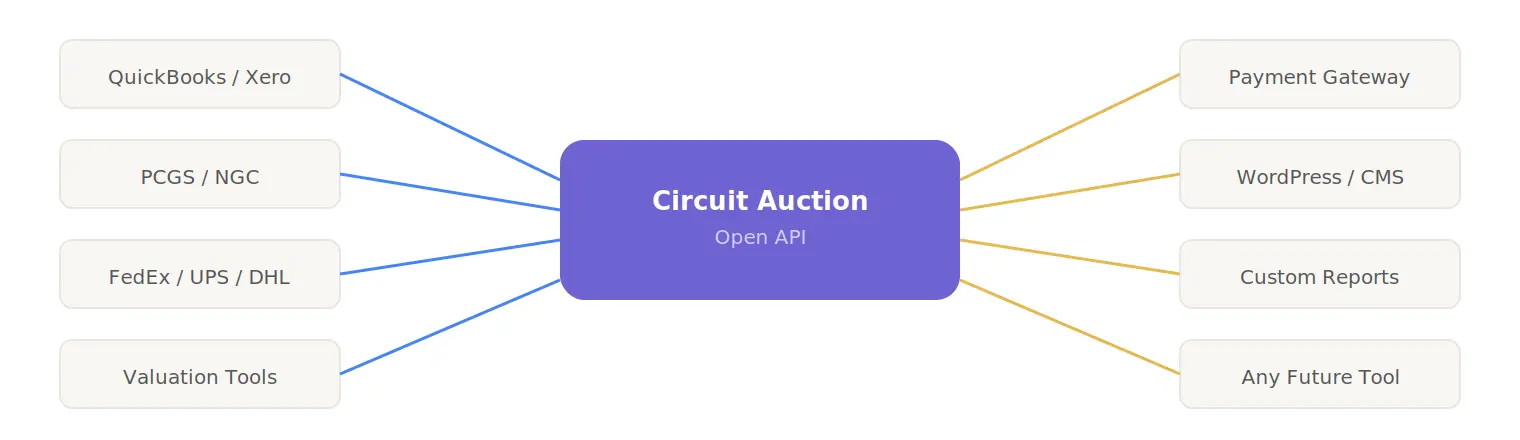
This is the most consequential architectural decision when choosing collectibles auction software.
Circuit Auction covers the complete operation within a single environment. And when your needs evolve, a full API connects to anything: accounting software, shipping logistics, external valuation tools, authentication services, custom reporting dashboards, or any integration your business requires.
A platform with an API-first architecture gives you everything integrated today and unlimited flexibility tomorrow. Platforms without open API access build walls around your operation. You will not feel those walls until the day you need to get data out, connect a new tool, or build a workflow the platform did not anticipate.
How to Choose Collectibles Auction Software: 7 Questions That Matter
If you are evaluating collectibles auction software for your auction house, ask these questions. If any answer is vague, keep looking.
01 Who owns the data if we leave?
02 Is the platform white-label, fully our brand and domain?
03 Is there full API access for any integration we need?
04 What is the measured response time during a live sale under real load?
05 Does settlement carry consignor terms automatically from agreement to payout?
06 Does the system adapt to our workflow, or do we adapt to yours?
07 What does support look like in month twelve?
Why Auction Houses Choose Circuit Auction
Circuit Auction is the only auction management software purpose-built for collectibles. It combines thirty years of auction industry experience with modern AI technology and the fastest live bidding engine available.
The fastest platform. Measurably faster response times than any competing auction software.
True all-in-one. Cataloging, AI, live bidding, CRM, invoicing, shipping, settlement, marketing, analytics, and compliance in one system.
Agentic AI cataloging. Not passive tools. AI that identifies items, writes descriptions, suggests estimates, and maintains your voice.
Full data ownership. Your bidders, your data, your domain. Always.
Open API. Connect to anything. No lock-in. No walls.
Built for collectibles. 20 specialized modules for coins, stamps, sports cards, fine art, antiques, rare books, watches, sports memorabilia, militaria, vintage posters, and more.
White-label websites with SEO. Your brand online, optimized for search, attracting new bidders organically.
Flexible selling. Timed, live, hybrid, private treaty, and buy-now from one platform.
Global reach. Multi-language, multi-currency, international shipping integration.
Built by auctioneers. Not by a software company that discovered auctions last year. Meet the auction houses that run on Circuit.
Book a 30-Minute Demo — In 30 minutes, we will show you how Circuit Auction handles your specific operation. No pressure. No commitment. Just a clear look at what the platform does.
Frequently Asked Questions About Collectibles Auction Software
What is auction management software?
Auction management software is a platform that handles the complete operation of running an auction house, from cataloging and marketing through live bidding, invoicing, payment collection, shipping, and consignor settlement. Circuit Auction is an all-in-one auction management platform designed specifically for collectibles auction houses.
What software do auction houses use?
Professional auction houses use dedicated auction management software to run their operations. Circuit Auction is used by collectibles auction houses specializing in coins, stamps, sports cards, fine art, and antiques. The platform handles cataloging, live bidding, CRM, invoicing, shipping, and settlement in one system.
How much does auction management software cost?
Circuit Auction uses predictable flat monthly pricing rather than commission-based fees. Unlike platforms that charge 1 to 5 percent of sales, Circuit’s cost stays the same regardless of your auction volume. This means the platform becomes more cost-effective as your business grows.
What features should auction software have?
Essential features include AI-powered cataloging, real-time live bidding, automated invoicing and settlement, bidder CRM, white-label branding, full data ownership, open API access, shipping integration, accounting export, mobile support, multi-language capabilities, and AML/KYC compliance tools. Circuit Auction includes all of these.
Does Circuit Auction support coin and numismatic auctions?
Yes. Circuit Auction includes specialized fields for coins including date, mint mark, denomination, metal, grade, and variety. PCGS and NGC certification numbers integrate directly into lot records. AI image recognition identifies coin types and suggests descriptions.
Does Circuit Auction support stamp and philatelic auctions?
Yes. Circuit Auction supports Scott and Stanley Gibbons catalog numbers, perforation measurements, watermarks, gum condition, and postal history descriptions. High-resolution imaging tools support the detail required for accurate stamp presentation.
Does Circuit Auction support sports card auctions?
Yes. Circuit Auction displays PSA, BGS, SGC, and CGC grades prominently in lot listings with card-specific fields including player, year, set, card number, variant, and parallel. The mobile-first interface serves the younger demographic active in sports card collecting.
Does Circuit Auction support fine art auctions?
Yes. Circuit Auction provides comprehensive provenance documentation, exhibition records, publication references, authentication certificates, and condition reports. The platform handles Artist’s Resale Right (ARR) calculations for UK/EU sales and VAT Margin Scheme compliance.
Can I migrate from my current auction software to Circuit Auction?
Yes. Circuit Auction provides professional data migration services. Historical auction results, bidder records, consignor information, and catalog data can be imported from existing systems with full data integrity. Most auction houses go live within two to four weeks.
Does Circuit Auction integrate with accounting software?
Yes. Circuit Auction integrates with QuickBooks, Xero, and other financial software. Invoices, payments, buyer fees, and tax breakdowns sync automatically, eliminating double entry.
Does Circuit Auction integrate with shipping providers?
Yes. Circuit Auction integrates with FedEx, UPS, DHL, and USPS for label generation, insurance calculation, tracking, and customs documentation for international shipments.
Is Circuit Auction white-label?
Yes. Circuit Auction runs on your domain with your brand, your logo, and your design. Bidders see your auction house, not a software platform. Circuit also builds and hosts your website with SEO optimization included.
Who owns the data in Circuit Auction?
You do. All bidder records, lot history, images, and transaction data belong entirely to your auction house. You can export everything in standard formats at any time. Circuit Auction does not share your data with other auction houses or use it for cross-selling.
How fast is Circuit Auction’s live bidding?
Circuit Auction is the fastest auction management platform available. Live bids synchronize across all channels, including room, phone, online, and mobile, with zero perceptible latency. The speed advantage is measurable in direct comparisons with competing platforms.
Does Circuit Auction support AML and KYC compliance?
Yes. Circuit Auction includes built-in identity verification, compliance documentation, and audit trails to meet AML/KYC requirements. This is particularly relevant for fine art and high-value collectibles transactions under evolving regulations.
Does Circuit Auction have an API?
Yes. Circuit Auction provides full API access for custom integrations with any external system: accounting software, shipping logistics, valuation tools, authentication services, or custom reporting. The API-first architecture ensures your operation is never locked into a closed system.