
Updated September 2026. This guide has been revised to reflect what auction houses are actually asking for in 2026: white label platforms on their own domain, AI cataloging that specialists trust, and a CRM that lives inside the auction system rather than beside it. The evaluation checklist and FAQ have been updated accordingly.
Running a successful auction house today requires more than expertise and relationships. Professional auctioneers face growing expectations from bidders who want seamless mobile bidding, real-time updates, and the ability to place bids from anywhere. Meanwhile, auction houses struggle with fragmented software systems that multiply workload instead of reducing it.
The good news? The best auction software can genuinely transform how you operate—if you choose the right platform.
Why Auction Houses Struggle with Fragmented Auction Software Systems
Most auction houses operate with multiple disconnected systems: one software solution for cataloging, another for live auction operations, a third for invoicing, and a spreadsheet or generic CRM for consignors. Each platform works in isolation.
The consequences add up quickly. Staff enter the same data multiple times. Your bidding platform doesn’t communicate with your inventory management system. When bidders call asking about an invoice, your team hunts through three different platforms to find answers. Settlement takes days instead of hours because systems don’t share information.
For auction houses specializing in collectibles—coins, stamps, sports cards, fine art—the challenges multiply. These auction items require detailed cataloging, precise photography, and specialist knowledge. Generic event software wasn’t built for this level of sophistication.
What the Best Auction Software Actually Delivers in 2026
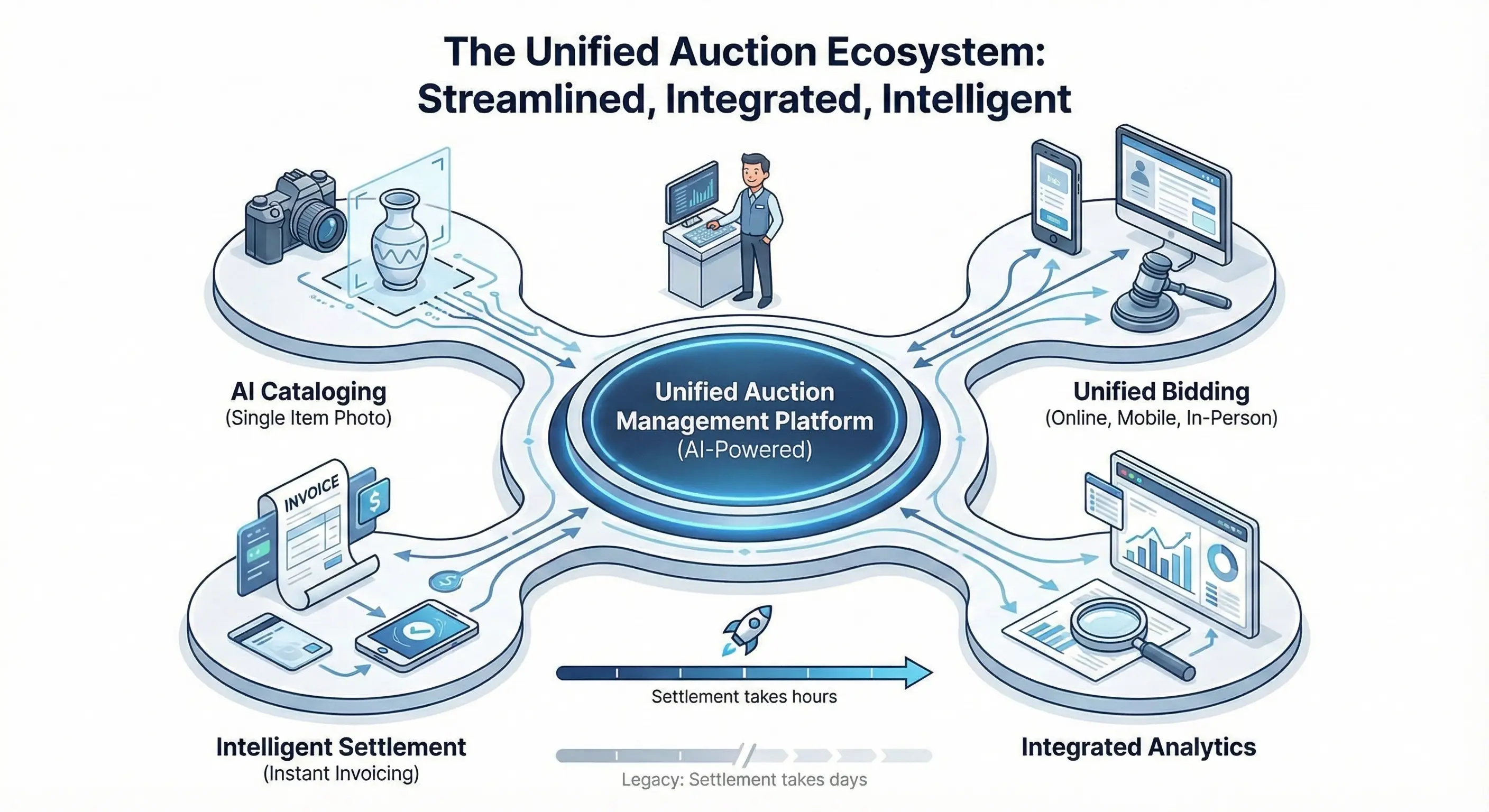
The best auction software for 2026 treats your operation as a unified ecosystem rather than separate tasks requiring separate tools.
Consider catalog production. In traditional systems, staff photograph items, manually type descriptions, upload images separately, create lot numbers in another platform, and hope everything synchronizes across your auction catalog and bidding platform. Each handoff introduces errors and wastes time.
Modern auction management software works differently. You photograph an item once. AI cataloging analyzes the image and suggests descriptions based on visual recognition. The system generates lot numbers automatically and optimizes images for your auction website and mobile bidding software simultaneously. Everything becomes available across all channels—online auctions, mobile bidding platform, and in-person stations—without duplicate entry, thanks to our innovative auction technology.
Modern auction houses rely on one integrated system to unify cataloging, bidding, and settlement.
How AI Makes Cataloging Practical
Many auctioneers approach AI with healthy skepticism, and for good reason. The term “AI-powered” gets overused in software marketing. But practical AI applications genuinely improve auction operations.
AI cataloging doesn’t replace specialist knowledge—it amplifies efficiency. When you photograph a Morgan silver dollar, AI-powered image recognition identifies the date, mint mark, and probable grade. When you scan stamps, computer vision detects perforations and watermarks, making the process more user friendly for collectors. When you catalog sports cards, machine learning recognizes players, years, and conditions.
AI Cataloging, Image Recognition, and Faster Live Auction Workflows
Technologies like YOLOv8 enable real-time object detection, processing images in milliseconds. When properly integrated into auction software designed for professionals, these capabilities transform catalog production from a bottleneck into a streamlined workflow.
AI also helps in other areas. During live bidding, AI monitoring can detect unusual bidding activity patterns that might indicate problems. In marketing, AI analyzes data and insights from past auctions to predict optimal reserve prices. For bidder engagement, AI-powered systems identify which auction items might interest specific collectors based on their history.
The auction software company that understands this treats AI as infrastructure—working quietly in the background to save time and reduce errors, making the platform more user friendly.
Why Integration Matters for Your Auction Business and Bidding Platform
When your auction platform integrates cataloging, bidding, settlement, and analytics into one user friendly system, operations become dramatically simpler.
Bidders register once and can participate across every auction you run—timed online auctions, live sales with internet bidding, and traditional floor sales. Their payment information carries forward. Their bidding history enables personalized recommendations.
For your staff, integration eliminates double entry and manual reconciliation. When a bidder calls about an invoice, your team sees their complete history in one view: items won, payments made, shipping preferences. When you analyze which auction package generated the most revenue, you’re looking at unified data rather than exports from multiple platforms.
A timed auction module that can’t communicate with your live auction platform creates confusion for bidders and operational headaches for staff. Mobile bidding software that doesn’t synchronize in real-time with floor bidding creates latency issues that cost you winning bids.
Cloud-based auction software enables access from anywhere. Specialists can review catalog entries from home. Leadership can monitor a live sale from another city. Your accounting team can generate invoices the moment the hammer falls on the last lot.
Practical Implementation: What You Can Do Tomorrow
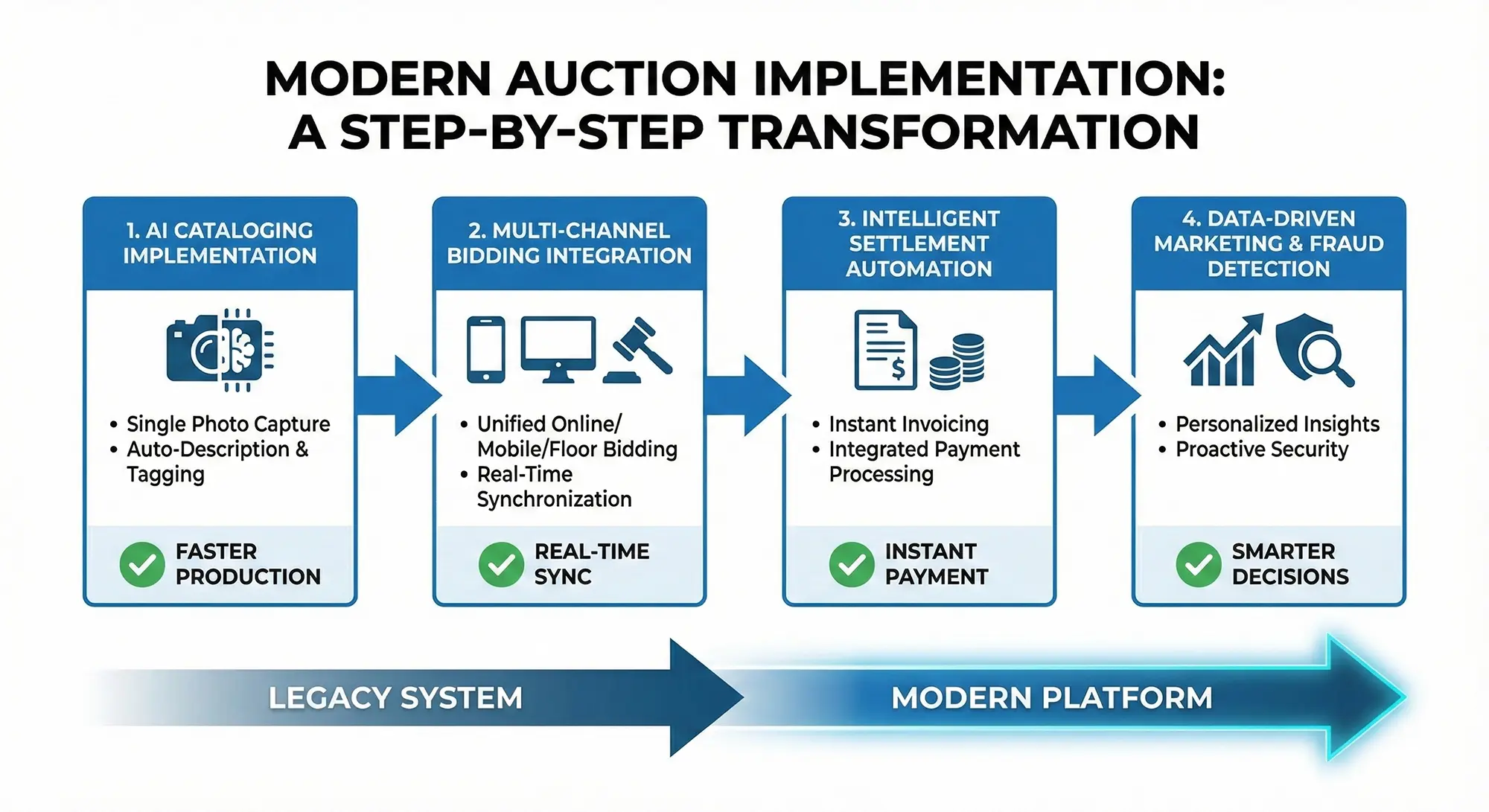
Modern auction management looks like this in practice, leveraging advanced auction technology.
Catalog Production: You photograph coins with your phone. The AI cataloging system identifies denominations and dates, suggests descriptions, and flags potential key dates for specialist review. What used to take hours now takes minutes. Your specialists focus on verification and refinement rather than data entry.
Multi-Channel Bidding: A collector in Tokyo browses your auction catalog on a mobile app at midnight. They set maximum bids. When your live auction begins in New York six hours later, their bids execute automatically. Floor bidders see real-time competition from online participants. The auctioneer knows instantly whether a floor bid beat an absentee maximum or if online bidders remain active. Every bid from every channel—mobile bidding, online, telephone, and floor—synchronizes without latency issues.
Intelligent Settlement: When the auction concludes, the system generates invoices for every winning bidder within seconds. It applies buyer’s premiums, calculates taxes based on jurisdiction, and sends payment links. Bidders can pay immediately via credit card, ACH, or wire transfer. The software includes automatic payment reminders and updates your inventory management system to mark items as sold, enhancing event management.
Fraud Detection: During a high-value auction, AI monitoring detects unusual patterns—two bidder accounts repeatedly driving up prices on the same category, both registered from similar IP addresses. The system flags this for review, giving your team the data and insights needed to investigate before it affects auction integrity.
Marketing Intelligence: Two weeks before your next auction, the platform analyzes past bidding data to identify which registered bidders are most likely to participate based on catalog composition, aiming for the winning bid. It automatically sends personalized previews featuring auction items that match each collector’s interests.
Measuring Real Return on Investment
Let’s talk about actual numbers. Auction business economics improve through compounding efficiencies:
Time Savings: Automated catalog production cuts data entry by 70-80%. What required three full-time staff members now requires one specialist focused on verification. For a mid-sized auction house running 24 auctions annually, that recovers roughly 2,000 hours—time you can reinvest in consignment development or bidder relationships.
Error Reduction: Manual data entry introduces mistakes, making auction technology even more crucial for accuracy. Wrong lot numbers, incorrect descriptions, and mismatched photographs can be easily corrected with our user friendly auction technology. AI-assisted cataloging reduces these errors by 85-90%, creating a more professional auction experience.
Bidder Expansion: When you offer seamless mobile bidding and a user-friendly online auction platform, you expand your addressable market from local participants to global collectors. Auction houses typically see 40-60% increases in registered bidders within six months of implementing modern mobile bidding platforms.
Settlement Efficiency: Automated invoicing and integrated payment processing accelerate cash flow, making the process easy and quick. Instead of waiting days for manual invoice generation, bidders receive payment requests within minutes. Fast payment improves consignor satisfaction.
Market Intelligence: When every auction generates structured data, you build an analytical asset that informs future strategy. Which categories draw the most new bidders? Which marketing channels drive bidder registration? Which lot sequences maximize participation? An auction house CRM that sits inside the auction system answers those questions from real bidding records instead of exported spreadsheets.
What Software Realistically Can and Cannot Do
Modern auction management software in 2026 is powerful but has limits worth understanding.
AI cataloging accelerates production dramatically but doesn’t replace specialist expertise. A neural network can identify a Morgan dollar but can’t assess eye appeal, strike quality, and market desirability the way an experienced numismatist can. The software lets specialists operate at higher leverage while human judgment remains essential.
Integration solves many operational problems but doesn’t eliminate the need for thoughtful process design. If your consignment agreements are unclear, software won’t fix them. If your lot description standards are inconsistent, automation will perpetuate those inconsistencies faster.
Technology improves bidder access but doesn’t replace the theater and excitement of a well-run live auction. The auctioneer’s skill, the rhythm of the sale, the psychology of competition—these human elements remain central to the perfect auction experience. Online auction software extends reach without replacing performance.
The right auction software solution handles the mechanical, repetitive, and computational work—freeing your team to focus on relationships, expertise, and strategy, making it user friendly for all participants.
Making a Smooth Transition
Switching from legacy systems to modern auction management software requires planning. The concerns are valid: what if something breaks during the transition? What if staff resist change? What if bidders are confused?
These risks are manageable with the right approach.
Phased Implementation: Start with catalog production, where AI cataloging delivers immediate visible benefit. Once your team is comfortable, add mobile bidding software integration. Then expand to full back-office management with automated invoicing and settlement. Each phase builds confidence before asking staff to embrace the next change.
Genuine Training: The difference between software that gets adopted and software that gets abandoned often comes down to whether the software provider invests in genuine training—ongoing support until your team feels confident, not just a single webinar.
Careful Data Migration: Your historical auction data represents institutional knowledge. The transition to cloud-based systems must preserve this information while restructuring it for better future use.
Clear Bidder Communication: When you introduce new features like seamless mobile bidding or a branded auction platform, bidders need to understand what’s changing and why. Clear communication—“register once, bid from anywhere, in-person or virtual”—works better than technical explanations. Maintaining familiar touchpoints during the transition reduces anxiety.
Auction houses that navigate transitions successfully treat software modernization as a business transformation initiative. Leadership stays engaged during the check-in process. Staff receive support. Bidders see improvements that matter to them. And the software company acts as a partner.
The Industry’s Direction
The auction industry is evolving rapidly. Twenty years ago, serious collectors traveled to major cities to attend in-person sales. Today, those same collectors expect to browse auction catalogs from their phone, research comparable sales with a few clicks, place bids from anywhere, and receive items via coordinated shipping without visiting the auction house.
This shift is about access. A collector in Singapore can now compete for rare stamps that previously would have been accessible only to bidders within driving distance of the auction site. A regional auction house in rural Kansas can attract bidders from across the country without renting a bigger room. A new generation of collectors who grew up with smartphones finds mobile bidding platform interfaces more natural than printed catalogs.
Auction houses that thrive embrace technology as an enabler of their core mission: connecting buyers and sellers, establishing fair market value, and facilitating transactions that preserve historical artifacts and support collecting communities.
How Circuit Auction Approaches This
Circuit Auction builds the entire ecosystem with integration as the core architectural principle. When you run an auction on Circuit, you’re operating within a unified platform where every function—from consignor intake to winning bidder delivery—flows through one intelligent system.
The AI is woven throughout: suggesting catalog descriptions as you photograph items, predicting optimal lot sequences, monitoring bidding activity for anomalies, recommending reserve prices based on market analysis, identifying which bidders should receive outreach about specific upcoming auctions.
The live bidding platform ensures that whether someone uses seamless mobile bidding from a smartphone, places bids through your branded auction platform on desktop, participates via live chat during the auction, or raises a paddle in your salesroom, they experience fair, synchronized competition. No artificial delays, ensuring a smooth check-in process. No disconnect between online and live experiences.
The back-office management—invoicing, payment processing, shipping coordination, consignor statements—integrates tightly so that from a user-friendly operational perspective, settlement happens automatically. Staff effort focuses on exceptions and customer service rather than data management, enhancing the user friendly experience for all involved.
Circuit is also a white label auction platform. It installs as a WordPress auction plugin on the website you already own, so bidders register with your auction house, on your domain, and never see a third-party marketplace logo. The bidder list, the sale history and the consignor records stay yours.
For professional auction houses in specialized verticals—numismatics, philately, sports memorabilia, fine art—Circuit provides customizable cataloging templates and display options. Your auction catalog looks like your brand, follows your industry’s best practices, and gives bidders the detailed information they need to bid confidently.
For a feature-by-feature table against the main white label alternatives, see Circuit vs BidJS, Circuit vs Auction Mobility and Circuit vs Bidsquare Cloud.
The 2026 Evaluation Checklist
When auction houses compare platforms in 2026, the questions have shifted. Fewer people ask “can it take online bids?” and more ask who ends up owning the relationship. Use these questions in every demo:
- Whose domain do bidders register on? If the answer is the vendor’s, the bidder list is not really yours.
- Does the back office come with it? Cataloging, invoicing, consignor settlement and shipping should be in the same system as bidding, not bolted on.
- Can specialists override the AI? AI cataloging should draft, not decide. Look for one-click editing and a full change history on every lot.
- Is the CRM inside the auction system? Bidder interests, paddle history and consignor statements belong next to the lots they relate to.
- What does leaving look like? Ask for a sample data export before you sign, not after.
Is Modern Software Right for Your Operation?
If your current auction system works well—catalog production is efficient, bidders are happy with your online experience, settlement happens smoothly, your staff loves the tools they use, your data gives you strategic insights—then you may not need to change.
But if you’re spending too many hours on manual data entry, if your online auctions feel disconnected from in-person events, if bidders complain about mobile app performance, if invoicing creates bottlenecks, if you’re making strategic decisions based on intuition because pulling reports is too difficult—then modern software could genuinely help.
Circuit Auction provides an auction software solution built specifically for professional transformation, designed to be user friendly. We’re not a general-purpose event software platform trying to serve every industry. We’re an auction platform designed for serious auction companies running high-quality sales in specialized categories.
The software includes everything auction needs require: AI cataloging that accelerates production while maintaining specialist control, a live bidding platform that treats online, mobile, and floor participants as equals, comprehensive back-office management that makes settlement and invoicing effortless, analytics that turn auction data into strategic insight, and a mobile bidding software experience that bidders enjoy using.
We serve auction houses running coin auctions, stamp auctions, sports card sales, fine art auctions, and other collectibles categories where expertise, trust, and attention to detail matter. The auction software includes everything needed to run the perfect auction: from cataloging to settlement.
Modern auction houses deserve an auction software platform that simplifies online auctions, supports mobile bidding, and accelerates live auction operations. With the right auction management system, bidders enjoy a seamless experience while auction teams benefit from automated workflows, accurate cataloging, and faster settlement. Choosing modern online auction software is the fastest way to improve performance, reduce overhead, and compete effectively in 2026.
If this sounds relevant to your auction business, let’s have a conversation about how to secure the winning bid. We focus on understanding your specific challenges, providing honest assessments of fit, and offering transparent demonstrations of how the platform works in practice.
Ready to Transform Your Auction House?
See Circuit Auction in action. Book a personalized demo and discover how the leading auction houses streamline their entire auction operations—from AI cataloging to seamless mobile bidding to automated invoicing.
Book a Demo Today and join the auction companies that trust Circuit for every auction they run.
During your demo, you’ll see how user friendly our platform is for both bidders and auctioneers.
- Live AI cataloging processing real auction items in seconds
- Multi-channel bidding synchronizing online and live auctions in real-time
- Automated settlement generating invoices instantly
- White label setup running on your own domain, under your own brand
No pressure. No sales pitch. Just a clear look at how modern auction management software can transform your operations.
Frequently Asked Questions
What’s the typical implementation timeline for auction management software?
Most auction houses can go live with core features (cataloging, bidding platform, basic settlement) within 2-4 weeks. Full implementation including data migration, staff training, and advanced features typically takes 6-8 weeks. The key is phased rollout—start with one auction to build confidence before expanding to full operations.
How much does modern auction management software cost?
Pricing varies widely based on auction volume, features needed, and whether you choose subscription or transaction-based models. Expect $200-$500/month for basic platforms suitable for occasional auctions, $1,000-$3,000/month for mid-sized auction houses running regular sales, or transaction-based pricing (typically 1-3% of hammer price) for larger operations. Calculate ROI based on time saved, error reduction, and bidder expansion rather than just subscription cost. Circuit’s own pricing is published, with a 2% commission Standard plan and a fixed-price Enterprise plan.
Will our existing bidders struggle with new auction software?
Modern auction platforms are designed to be intuitive for bidders of all technical levels. The best systems offer multiple bidding options—mobile app, desktop browser, telephone, and in-person—so bidders can choose their comfort level. Clear communication during rollout (“register once, bid from anywhere”) and simple interfaces reduce friction. Most auction houses see bidder adoption rates above 80% within the first two auctions.
Can auction management software integrate with our existing accounting system?
Most professional auction platforms offer integration with QuickBooks, Xero, and other major accounting software through direct API connections or CSV exports. This eliminates double-entry of financial data and ensures your books stay synchronized. During software evaluation, verify that export formats match your accountant’s requirements and that settlement data flows cleanly into your existing processes.
Is AI cataloging accurate enough for valuable auction items?
AI cataloging is designed to assist, not replace, specialist expertise. For valuable items, think of AI as a highly efficient first pass that identifies basic attributes (dates, denominations, visible characteristics) while your specialists focus on authentication, condition assessment, and market positioning. Most auction houses report 85-90% accuracy on basic attributes, with specialists reviewing and refining before publication. The time savings are substantial—what took hours now takes minutes.
What happens if the software goes down during a live auction?
Reputable auction platforms operate with 99.9% uptime guarantees and maintain redundant infrastructure. However, backup plans matter. Look for systems that cache data locally on your auctioneer’s device, allowing the sale to continue even if internet connectivity drops. Your auctioneer should always have access to lot lists and current bids independent of the cloud platform. Additionally, verify the provider’s incident response time and whether they offer phone support during critical auction hours.
How do we handle the transition from our current system without losing historical data?
Professional auction software providers include data migration services as part of implementation. This typically involves exporting your historical auction results, bidder records, and consignor information from existing systems and mapping them to the new platform’s structure. The migration process should preserve searchable auction history, maintain bidder relationships, and keep consignment records intact. Request sample migration reports during evaluation to ensure no critical data gets lost in translation.
Does modern auction software work for specialized categories like stamps, coins, or fine art?
The best auction management systems offer category-specific features rather than generic templates. For numismatics, this means fields for grading services, mint marks, and varieties. For philately, it includes perforation measurements, watermark detection, and postal history. For fine art, it encompasses provenance tracking, exhibition history, and condition reporting. Generic event software struggles with these nuances—choose platforms built specifically for collectibles auctions.
About Circuit Auction
Circuit Auction is an all-in-one auction management platform for professional auction houses specializing in collectibles. Since 1995, we’ve been helping auctioneers modernize their operations through integrated cataloging, bidding, settlement, and analytics tools powered by AI.
Ready to see Circuit in action and experience its user friendly features? Book your personalized demo and discover why professional auction houses choose Circuit to save time, raise more money, and streamline operations.