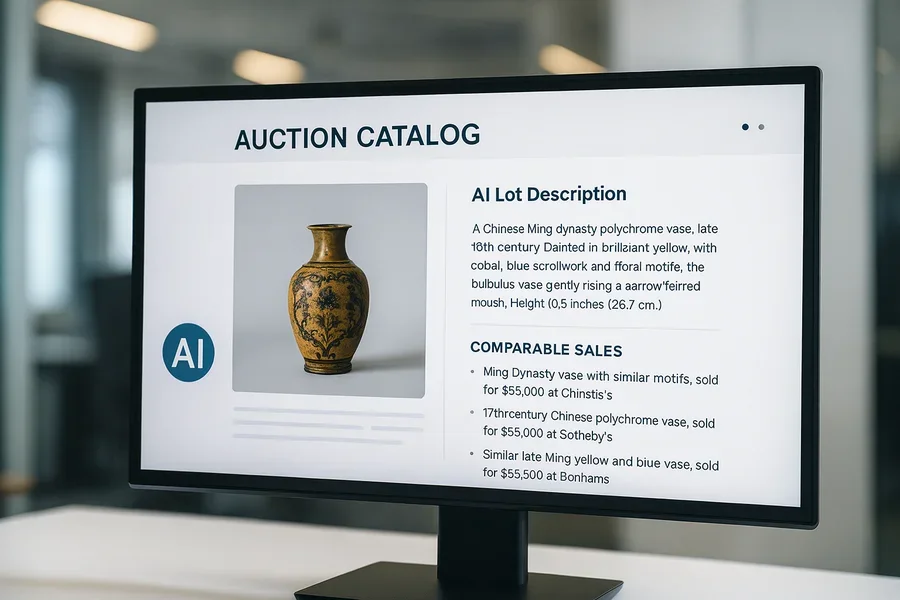
This Circuit Auction blog post explores how artificial intelligence is transforming the auction catalog creation process by accelerating research, description writing, and estimate setting while maintaining expert quality standards.
Traditional Challenges

Professional catalog creation historically demands weeks of labor per auction, requiring:
- Accurate identification of artists, makers, and provenance
- Condition assessment and documentation
- Market research for comparable sales
- Professional descriptions that engage collectors
- Technical specifications and measurements
- Historical context and significance
For a 200-lot auction, this process can consume 3-4 weeks of specialist time before a single catalog page is designed.
AI’s Role in Modern Cataloging

The article emphasizes a collaborative model where AI handles initial research and drafting while specialists provide expertise and judgment.
“The AI system correctly identified a 19th-century artist from a signature that took me 20 minutes to research manually.”
Key AI Applications:
- Image recognition: Identifies makers’ marks, signatures, and styles
- Market research: Analyzes comparable sales across databases
- Description drafting: Creates initial catalog descriptions
- Condition assessment: Identifies common issues from photos
- Estimate suggestions: Proposes ranges based on market data
Efficiency Gains

A case study shows a mid-size auction house reduced cataloging time from 3-4 weeks to 1 week for 200 lots after implementing AI-assisted cataloging. That is the workflow Circuit’s AI cataloging tools are built around: photograph the lot, review the draft, approve.
Time Savings by Task:
- Artist/maker identification: 70% faster
- Market research: 60% faster
- Description writing: 50% faster
- Estimate setting: 40% faster
Quality Assurance: The Human Element
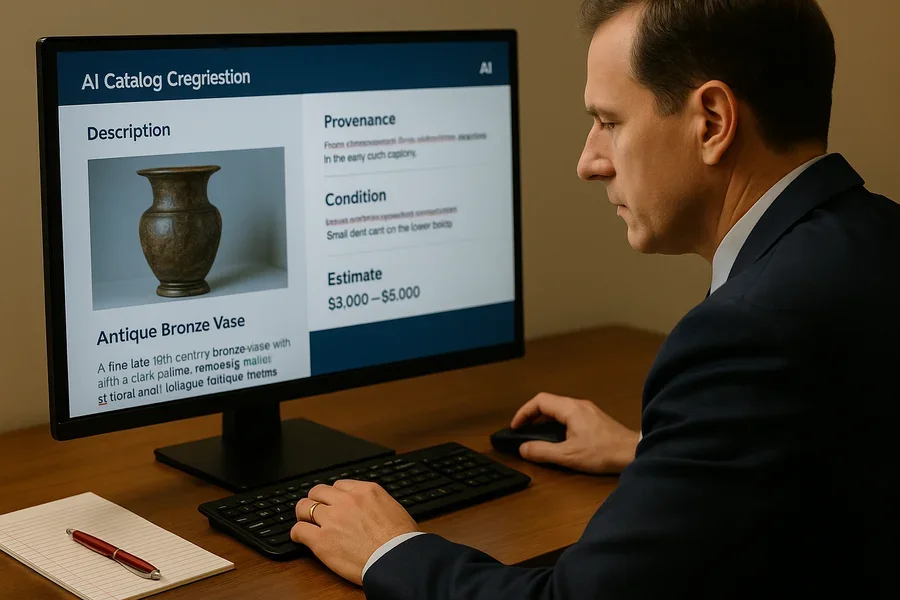
The post stresses that successful implementation requires human oversight at every stage. Experienced catalogers verify identifications, refine descriptions, and adjust estimates based on market knowledge. Whether specialists can override every AI draft is also one of the questions in our 2026 auction software evaluation checklist.
Critical Human Responsibilities:
- Verify AI identifications against expertise
- Refine descriptions for accuracy and appeal
- Adjust estimates based on market conditions
- Assess condition issues AI might miss
- Add contextual details that engage collectors
- Ensure authenticity and provenance accuracy
Measurable Benefits
Beyond speed, improvements include:
- Enhanced consistency: Uniform formatting and detail levels across lots
- Deeper research: AI finds connections humans might miss
- Reduced attribution errors: Multiple data sources cross-verify identifications
- Scalability: Handle larger sales without proportional staff increases
- Knowledge retention: AI learns from specialist corrections
Implementation Strategy

The article recommends:
- Start small: Implement AI for specific collecting categories
- Train staff: Ensure catalogers understand AI capabilities and limitations
- Establish protocols: Create clear quality assurance procedures
- Monitor results: Track accuracy rates and time savings
- Refine continuously: Update AI training based on specialist feedback
The Future of Cataloging
AI won’t replace experienced catalogers—it amplifies their expertise. The most successful auction houses will be those that effectively blend AI efficiency with human judgment, market knowledge, and collector relationships, which is exactly how Circuit Auction’s AI-driven auction house platform is designed to work.
“AI handles the research grunt work, freeing our specialists to focus on what they do best: evaluating quality, spotting exceptional pieces, and building collector relationships.”
Common Concerns Addressed
Will AI make catalogers obsolete?
No. AI enhances cataloger productivity but can’t replace expertise in authenticity assessment, market evaluation, and collector communication.
How accurate is AI identification?
Current systems achieve 85-95% accuracy for clear maker’s marks and signatures. However, human verification remains essential, especially for attribution and authenticity questions.
What about rare or unusual pieces?
AI performs best with well-documented categories. Rare or unusual pieces still require significant specialist research and expertise.
Frequently Asked Questions
How much does AI cataloging technology cost?
Modern auction management platforms like Circuit Auction include AI cataloging features as part of comprehensive subscriptions, typically costing less than hiring additional cataloging staff while delivering faster results.
Do I need technical expertise to use AI cataloging?
No. Modern systems are designed for auction specialists, not programmers. Training typically takes 1-2 days, with ongoing support available. A 30-minute demo is the quickest way to see the workflow on your own lots.
Can AI handle all collecting categories equally?
AI performs best in categories with extensive historical sales data and clear maker identification systems. Fine art, antiques, and collectibles with maker’s marks benefit most. Emerging categories may have limited AI capabilities initially.
How does AI learn from corrections?
When specialists correct AI identifications or descriptions, those corrections inform future suggestions. Over time, the system learns your auction house’s standards and preferences.
What about confidential consignments?
Reputable AI systems maintain strict data privacy. Consignment information used for research isn’t shared externally, and you retain complete control over data usage.
Will this technology improve over time?
Yes. AI cataloging systems continuously improve as they process more auctions and receive specialist feedback. Early adopters benefit from systems that learn and adapt to their specific needs.