AuctionFlex has been the back office of the American auction business for two decades. Thousands of auctioneers clerk, invoice and settle in it, and its sister marketplace HiBid puts their catalogs in front of a large bidding audience. If you are reading this, you probably run it, and it probably works.
The complaint we hear is not about the clerking. It is about what happens between sales. AuctionFlex knows a bidder as a number and a mailing address. It does not know that the same person underbid on three Winchesters in March, opened your last two catalog emails, asked for a condition report on a Colt, and consigned an estate in 2024. That is the information an auction house uses to grow, and it lives in your staff’s heads or in a spreadsheet next to the software.
This guide covers the alternatives an auction house can shortlist in 2026, and it judges them on the thing AuctionFlex is weakest at. We build one of them, so read the Circuit section with that in mind.
Why Auction Houses Look for an AuctionFlex Alternative
The client record is a mailing label. AuctionFlex’s contact tools are built around bidder numbers, mailing lists and invoice history. What an auction house needs is a relationship record: who this client is as a bidder, as a consignor and as a prospect, with every interaction attached. Check the current feature list before you decide, but ask specifically for interest tracking tied to lots, email engagement, and a consignor-side pipeline.
The bidders belong to HiBid. AuctionFlex’s online bidding runs through HiBid. Bidders register with HiBid, bid on HiBid and get HiBid’s emails about everyone else’s sales. Your auction house is a tile in their grid. This is the same trade every marketplace offers; we cover HiBid’s current fees and the marketplace side of the move in HiBid alternatives, and the mechanics in our guide to LiveAuctioneers alternatives.
Two systems, two client lists. Most auction houses that stay on AuctionFlex end up bolting on a general-purpose CRM or an email tool. Registrations and results are exported after each sale and imported into the other system. Within a year, the two lists disagree.
Follow-up is manual. Underbidders on a category, consignors who have not called back, buyers who opened the catalog but did not register: none of those lists exist in AuctionFlex. Someone has to build them by hand, so mostly nobody does. We wrote about the cost of that in why most consignors never call you back.
What a Real Auction House CRM Has to Do
Before comparing products, agree on the bar. An auction house CRM is not a sales pipeline with paddle numbers added. It has to:
- Hold both roles on one record. A client is a bidder, a consignor, or both. Purchases and consignments sit side by side.
- Link to auction objects, automatically. Every bid, hammer price, invoice, payment, consignment and statement attaches to the client with no export step.
- Track interests from behavior. What a collector bids on and underbids on is a better signal than the note a specialist wrote three years ago.
- Track email engagement. Who received the catalog announcement, who opened it, who clicked through to a lot. Without this, “we emailed everyone” is the end of the marketing report.
- Produce the follow-up lists. Underbidders by category, lapsed buyers, consignment leads without a next action, licensees with an expiring FFL.
- Cover the consignor side. Intake, agreement, lot list, commission, statement and payout, on the same record as the client’s purchases.
Score every alternative below against that list, including us.
AuctionFlex Alternatives That Run on Your Own Website
Circuit Auction AI
Circuit runs the whole auction house inside the website you already own. It installs as a WordPress auction plugin, with custom sites supported, and covers consignment intake, AI cataloging, timed and live bidding with a clerk console, absentee bids, invoicing, consignor settlement and shipping.
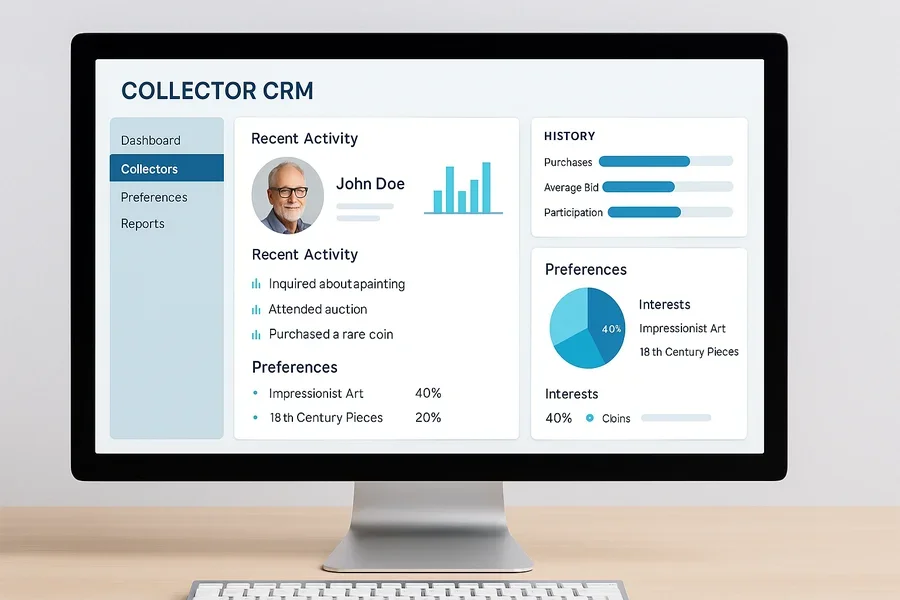
The auction house CRM is the part built to answer the AuctionFlex complaint. One record per client with bidder and consignor roles. Bidding history and underbidder tracking across every format. Interests recorded from behavior and from staff notes, with category alerts that fire when a matching lot is catalogued. Every email the platform sends, from catalog announcements to invoices to one-to-one messages, is logged on the client record with delivery, open and click status, so the follow-up list after a mailing is a filter, not a project. For firearms auction houses, FFL management sits on the same record.
Pricing is published: a standard plan at a flat monthly rate plus a small commission on online bids, or an enterprise plan with no commission. It is built for auction houses selling collectibles, firearms, militaria, fine art, antiques and similar categories, not for charity events or general merchandise liquidation.
AuctionMobility
A white label live and timed bidding platform with branded mobile apps. Strong bidder-facing experience; cataloging, CRM and back office are usually handled elsewhere, so it replaces the HiBid side of AuctionFlex rather than the AuctionFlex side.
Bidsquare Cloud
Bidsquare’s own-website product, with syndication to the Bidsquare marketplace. Aimed at fine art and antiques auction houses. Good middle path for an auction house that wants its own bidding page and still values a marketplace audience.
BidWrangler
Branded online bidding popular with estate and general auction companies in North America. The closest cultural fit to an AuctionFlex user, and lighter on specialist cataloging and CRM depth.
AuctionWorx by RainWorx
A configurable auction platform, closer to a framework than a finished product. Right for an auction house with technical staff who want to build something specific.
AuctionFlex Alternatives That Are Back-Office Systems
If the goal is to replace the clerking and invoicing side and keep listing on marketplaces, these are the usual names.
Wavebid
Cloud-based auction management for cataloging, clerking, invoicing and settlement, with feeds to HiBid, Proxibid, LiveAuctioneers and others. The most common “AuctionFlex but in the browser” choice. Client tools follow the same bidder-number model, so check the CRM bar above before assuming it solves that problem.
Auction Flex 360
AuctionFlex’s own cloud successor. If your complaint is only that the desktop version feels old, this is the shortest move. If the complaint is the CRM, it is the same company’s model.
Bidpath
Auction management with own-branded online bidding, used by auction houses in the US and UK. Worth a look for an auction house that wants back office and bidding from one vendor without a marketplace in between.
What Email Tracking Changes in Practice
The single feature auctioneers moving from AuctionFlex notice first is not the clerk console. It is seeing, the morning after a catalog announcement, a list of who opened it and who clicked a lot.
Here is what that turns into over a season:
- A pre-sale call list that writes itself. Clients who opened the catalog twice and clicked three lots get a call from the specialist. Clients who did not open it get a second email with a different subject line.
- Underbidder follow-up that lands. After the sale, underbidders on a category get the “similar lots next sale” email. Open and click data tells you which of them are still in the market.
- Consignor outreach with evidence. A consignment lead who opened your “what your collection might bring” email three times is a different conversation from one who never opened it.
- A clean list. Bounces and never-opens are visible, so the mailing list stops being a number and starts being an audience.
None of this is possible when the CRM is a mailing list and the email tool is a separate product that does not know what a lot is.
Comparison: What to Score
| Requirement | AuctionFlex + HiBid | Circuit Auction | Wavebid | AuctionMobility |
|---|---|---|---|---|
| Clerking, invoicing, settlement | Yes | Yes | Yes | Partial, needs back office |
| Online bidding on your own domain | No, on HiBid | Yes | Via feeds to marketplaces | Yes |
| One record for bidder and consignor | Basic contact record | Yes | Basic contact record | No |
| Interests from bidding behavior | No | Yes | No | No |
| Email open and click tracking on the client record | No | Yes | No | No |
| Underbidder lists by category | Manual | Yes | Manual | No |
| FFL on the client record | No | Yes | No | No |
| Who owns the bidder registration | HiBid | The auction house | Marketplace | The auction house |
Feature lists change. Treat the table as the questions to ask on each vendor’s demo, and correct any cell the vendor can disprove.
How to Move Off AuctionFlex Without Losing a Sale
- Export everything. Bidder and consignor lists, invoice history and past catalogs. Every serious alternative imports them, and the history is what makes the new CRM useful on day one.
- Run the next sale in parallel. Clerk in the new system and keep the old one open for reference. Catalog on your own site and, if your audience still comes from HiBid, list there too for the first sale or two.
- Email your buyers from the new platform. The first catalog announcement from your own domain, with tracking on, gives you a baseline you have never had: how many of your bidders actually open your email.
- Build three lists in week one. Underbidders from the last two sales, buyers who have not bid in twelve months, and consignors without a next action. Assign them.
- Measure the marketplace share. After three sales, look at what share of online hammer came through HiBid. Keep listing there if it earns its commission, drop it if it does not.
The plan is the same one we recommend for auction houses leaving any marketplace. Regular bidders follow the auction house, not the software.
Making the Decision
If AuctionFlex clerks your sales fine and your growth problem is that nobody follows up, the alternative you want is the one with the CRM, not the one with the prettiest bidding page. Score the shortlist against the six requirements above, insist on seeing email engagement on a client record during the demo, and pick the system that makes the follow-up list a filter rather than a Friday afternoon.
About Circuit Auction
Circuit Auction is an all-in-one auction management platform for professional auction houses. It runs on your own website under your own brand, with AI cataloging, live and timed bidding, a built-in auction house CRM with email tracking, automated invoicing, consignor settlement and FFL management in one system.
Thinking about moving off AuctionFlex? Book a demo and ask to see a client record with bidding history and email engagement on it. That is the ten-minute test.