Auction Website Performance: Fast When It Matters, Visible to Every Search Engine
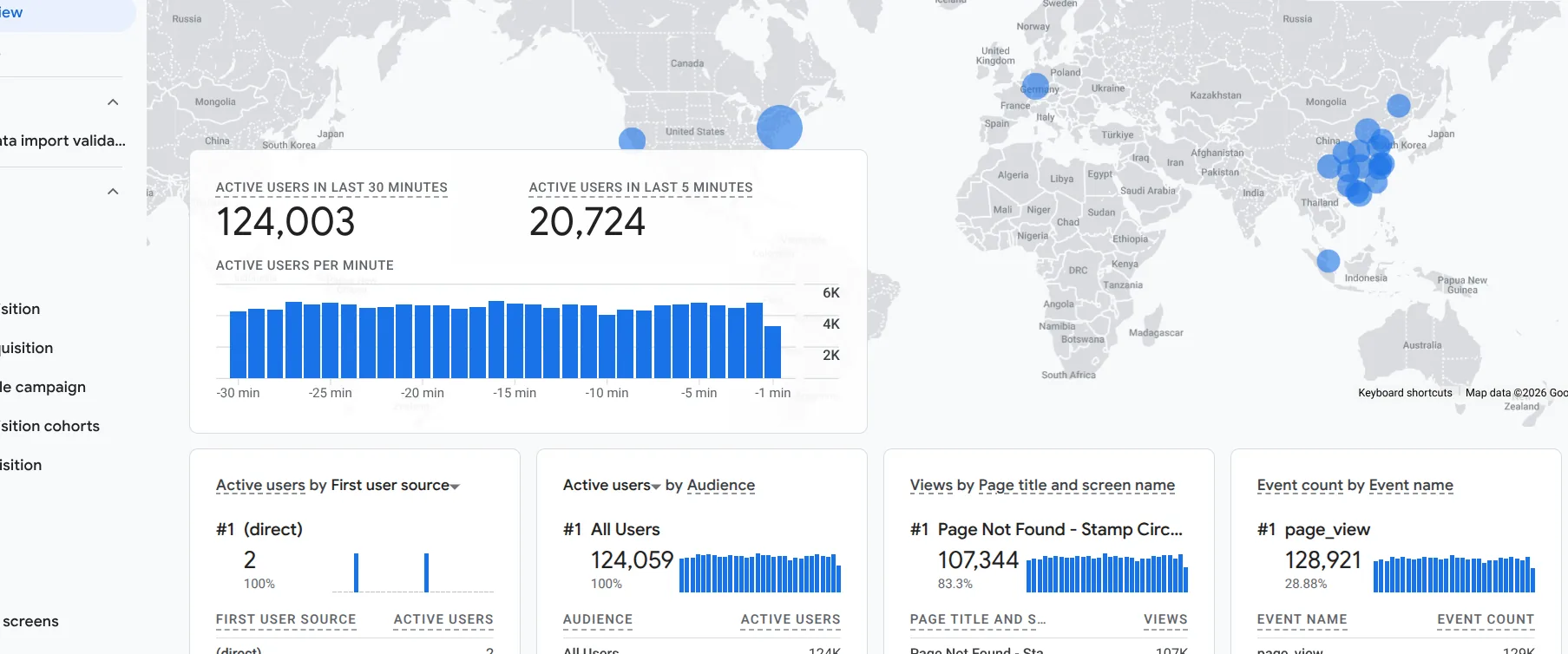
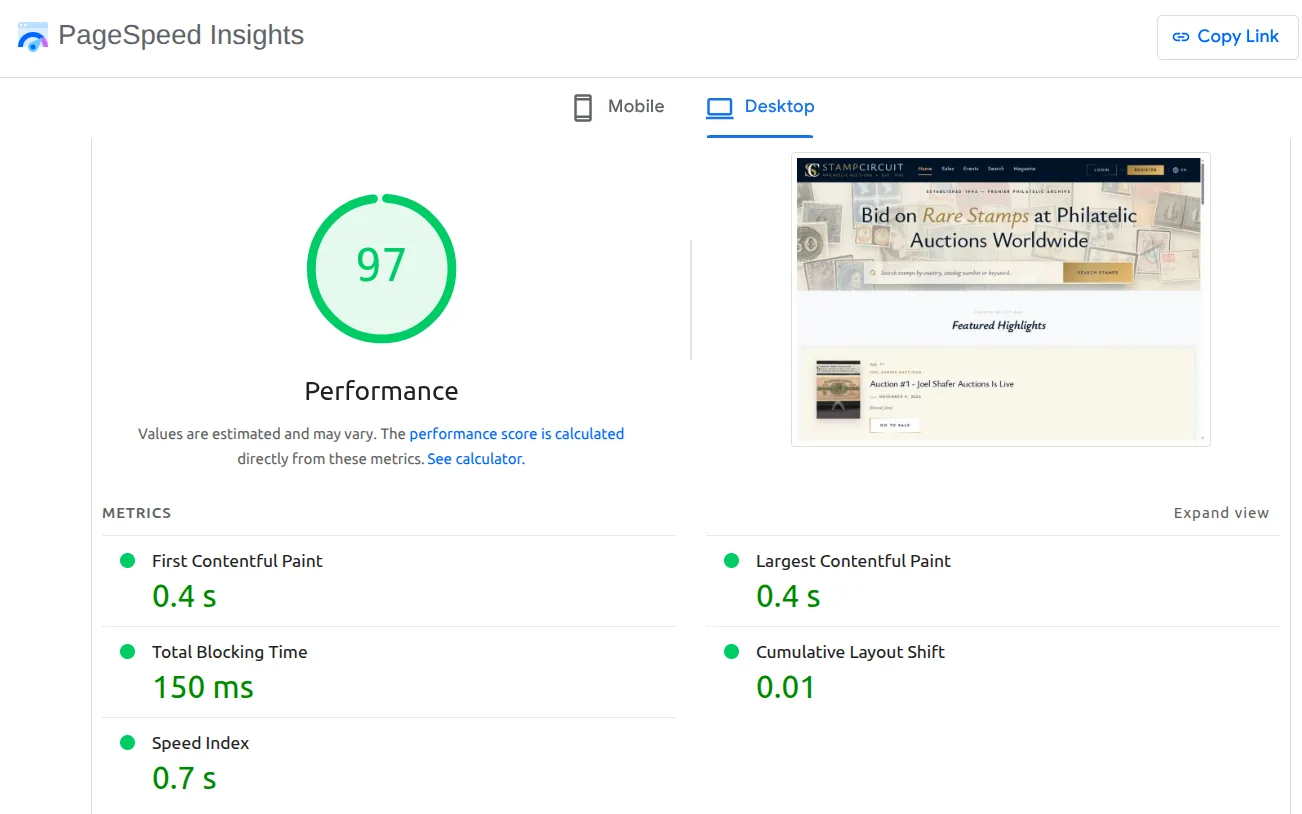
124,003 active users in 30 minutes. A 97 PageSpeed score measured while it was happening.
The Astro Auction Website absorbs bot and AI crawler surges at the edge, keep bidding isolated from page traffic, and never hide your catalog behind a challenge page that Google and AI assistants cannot pass.
Measured Under Load, Not on a Quiet Day
On November 7, 2026, Google Analytics showed 124,003 active users on Stamp Circuit, which runs on the Astro Auction Website, in 30 minutes, over 4,000 a minute, more than 90% of them bots and AI crawlers, 83% of them requesting pages that do not exist. We ran PageSpeed Insights on the homepage during the surge. These are the desktop results.
The full story, with the Cloudflare and Google documentation behind it, is in 124,000 visitors in 30 minutes, most of them bots.
Why the Usual Fix Costs You Bidders
When a bot surge hits, most sites switch on Cloudflare's Under Attack mode: a "Checking your browser" page that every visitor must pass before anything loads. Cloudflare calls it one of the last resorts and says it temporarily pauses access to the site. Many auction and dealer websites leave it on for months. Here is what it costs.
How Circuit Auction Websites Stay Fast
The decisions are made before the surge, not during it


Why Speed and Visibility Are Auction Results
Collectors Search by Category, Not by House
Most new bidders arrive from a search for a catalog number, an artist, a grade or a country, and increasingly from an AI assistant answering that question. Core Web Vitals are a ranking signal, and a site a crawler cannot read is not in the answer. Fast, readable lot pages are how a regional house competes with a marketplace for the same collector.
Mobile Bidders Leave Before a Slow Page Loads
Bidders browse catalogs on phones at odd hours and bid from a link in an email. A 0.4 second Largest Contentful Paint keeps them on the lot; a five-second challenge page or a three-second render sends them back to the marketplace tab.
Consignors Buy Reach
A consignor chooses your house for the buyers you can put in front of their lots. A catalog that is invisible to Google and AI assistants for the weeks a challenge page stayed on is reach they paid for and did not get. See consignment and settlement for the rest of the consignor experience.
Your Domain, Your Decisions
Because Circuit runs on your own website, you decide which crawlers are allowed and when visitors are challenged. On a marketplace, the operator makes those calls for every house on the platform at once.

Five Questions to Ask Any Auction Platform
Every demo shows the clerk console. Few show what happens to the bidder-facing site when traffic goes wrong. These are the questions, with Circuit's answers.
Auction Website Performance FAQ
On November 7, 2026, during a surge that put 124,003 active users on Stamp Circuit in 30 minutes, PageSpeed Insights scored the homepage 97 on desktop with a 0.4 second First Contentful Paint, a 0.4 second Largest Contentful Paint, 150 milliseconds Total Blocking Time and a Cumulative Layout Shift of 0.01. All of these are inside the thresholds Google rates as good, and the test was run while the surge was happening, not on a quiet day.
Catalog pages and 404 responses are served from the edge cache, so a flood of anonymous requests never reaches the application or the database. Rate limits and firewall rules target abusive patterns, not visitors in general. The bidding engine runs on separate resources from public page traffic, so a sale in progress is not slowed by a scraper discovering the catalog.
Not as a standing setting. Under Attack mode puts a JavaScript challenge page in front of every visitor, and Cloudflare describes it as one of the last resorts, one that temporarily pauses access to the site. Search engine crawlers and AI assistant fetchers are not documented as exempt and most AI fetchers do not run JavaScript, so a site left in that mode disappears from fresh indexing and from AI answers. Circuit sites are built so that this switch is not needed to stay up.
Yes. Verified crawlers, including Googlebot, Bingbot and the fetchers used by ChatGPT, Perplexity, Claude and Gemini, stay on an allow list in normal operation and during surges. Your lots, estimates, sale dates and results are readable by the search engines that send collectors to you and by the assistants that collectors increasingly ask first.
Directly. A slow catalog loses bidders on mobile before they see the lot, and a slow or challenged lot page at the close of a timed sale loses bids that were about to be placed. Page speed is also a Google ranking signal through Core Web Vitals, so a fast site ranks higher and brings in more of the collectors who search for a category, a catalog number or an artist rather than for your house by name.
The bidding, catalog and client pages that Circuit serves are delivered through the same edge-cached infrastructure whether your site is hosted by us or Circuit is installed on your existing site through the WordPress auction plugin. We will review your current hosting and DNS setup during onboarding and recommend the configuration that gives your bidders the same result.
Yes. Mitigation happens at the edge, in front of the application, and the bidding and client systems are isolated from public page traffic. Bidder records, invoices and consignor data are not exposed by traffic volume, and the platform's security and GDPR tooling continue to apply.
See It Measured Live
Book a demo and we will open the realtime traffic report and run PageSpeed Insights on a live Circuit auction site while you watch.
🏆 Bottom of Page Achievement Unlocked! 🏆
You're officially auction-software curious. Let's turn that curiosity into your success – use the form below and we'll talk details.
Write to Us