
In hybrid auctions, timing synchronization determines fairness. When online and in-room bids arrive nearly simultaneously, system delays can create conflicting records—one bidder believes they’ve won while the auctioneer has already moved forward, damaging trust.
The Hidden Risk in Modern Auctions
The article explains that in hybrid auctions, timing synchronization determines fairness. When online and in-room bids arrive nearly simultaneously, system delays can create conflicting records—one bidder believes they’ve won while the auctioneer has already moved forward, damaging trust.
Latency: The Technical Challenge Behind Confidence
Latency describes the delay as signals travel between bidder devices and auction servers. The platform argues that “fractions of a second can create uncertainty” when systems finalize lots before recognizing late-arriving bids. In timed auctions the same problem is handled by automatic bid extensions, one of the key differences between the two formats; in a live sale it has to be resolved at the moment of the hammer.
Why Speed Alone Is Not Enough
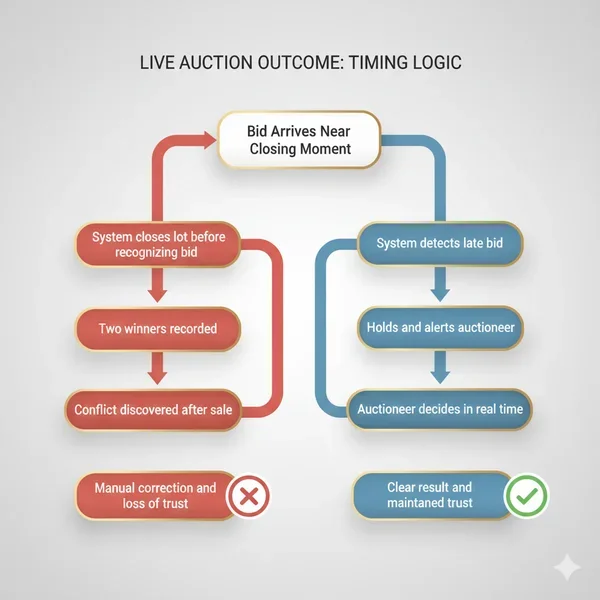
The article contends that “speed without context can harm reliability.” Platforms advertising instant processing may accidentally record multiple winners for a single lot. Instead, timing integrity—ensuring all participants share one consistent understanding—matters most.
The Circuit Auction AI Approach
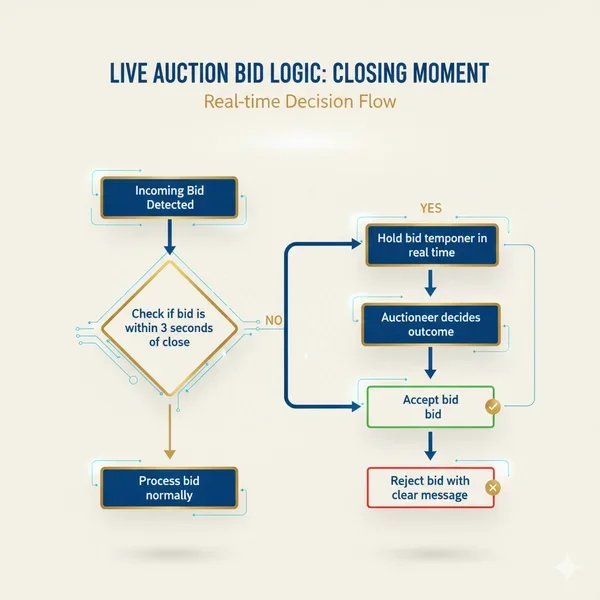
The Critical 3-Second Window:
- Holds bids temporarily when detected within 3 seconds of closing
- Alerts auctioneers with visual and audio notifications
- Empowers auctioneers to accept or reject bids
- Communicates outcomes transparently
When Two Bids Arrive Simultaneously
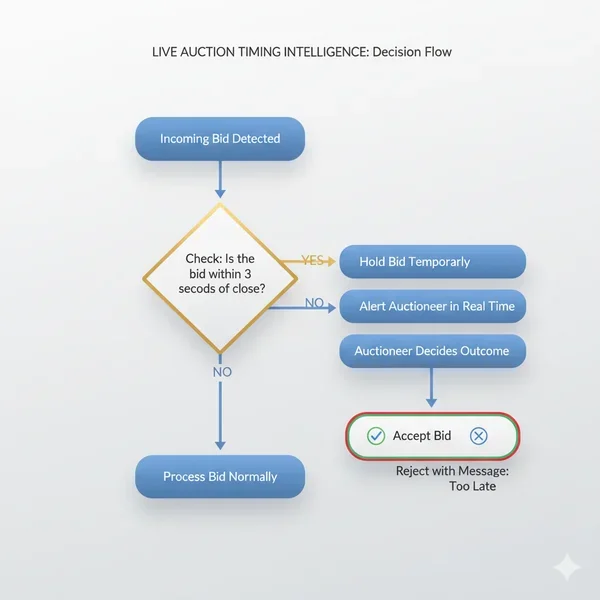
Circuit Auction AI gives auctioneers control to confirm or reject competing bids transparently, ensuring fairness even in microsecond-level timing scenarios.
Transparency and Authority
Two principles underpin bidder confidence: transparency and authority. The platform maintains the auctioneer as final decision-maker while synchronizing channels in real-time.
The Business Impact of Preventing Conflicts
Measurable Benefits:
- Zero post-sale contradictions
- 20-30% higher bidder participation
- Faster settlements
- Consistent growth in consignor confidence
Testing Your Own System
Auctioneers can test their systems by running practice sales with simultaneous bids from different channels to observe whether the platform alerts properly and resolves conflicts transparently.
Confidence as a System Outcome
When bidders trust infrastructure, they bid more aggressively, return for future sales, recommend the auction house, and accept outcomes without questioning processes. In high-value categories such as luxury watches or rare wine, where a single lot can run to five figures, that trust is the difference between a hesitant bid and a confident one.
Why Circuit Auction AI Has Become the Industry Standard
Core Technical Advantages:
- Real-time synchronization with sub-second precision
- Context-aware processing
- Auctioneer-centric design
- Transparent communication
- Conflict prevention
Implementation and Onboarding
Circuit Auction AI includes comprehensive training for staff, with most auction houses conducting live sales within days of onboarding.
Conclusion
The article argues that “only a few protect confidence” among auction platforms. Circuit Auction AI’s live bidding software for auction houses eliminates timing conflicts before they occur, maintaining auctioneer control and bidder clarity as the foundation of trust in modern auctions.
Run your first sale free using code CA25AI — book a demo to get started.
Frequently Asked Questions
What happens when a bid arrives during closing?
System detects bids within 3-second window, holds them temporarily, alerts auctioneer for informed decision, then communicates outcome transparently.
How does the system handle simultaneous room and online bids?
Platform presents all competing bids to auctioneer with full context; auctioneer maintains control to confirm which bid was recognized first.
Do bidders see when their late bids are rejected?
Bidders receive clear, immediate feedback explaining rejection timing with exact details.
How is this different from competitors?
Circuit prioritizes context over speed, preventing conflicts before they occur rather than requiring manual corrections.
What’s the impact on participation rates?
Auction houses report “20-30% higher bidder participation” due to increased trust in system fairness.
Can I test the system before committing?
Onboarding includes practice sales allowing simultaneous bids from multiple channels to demonstrate conflict prevention.