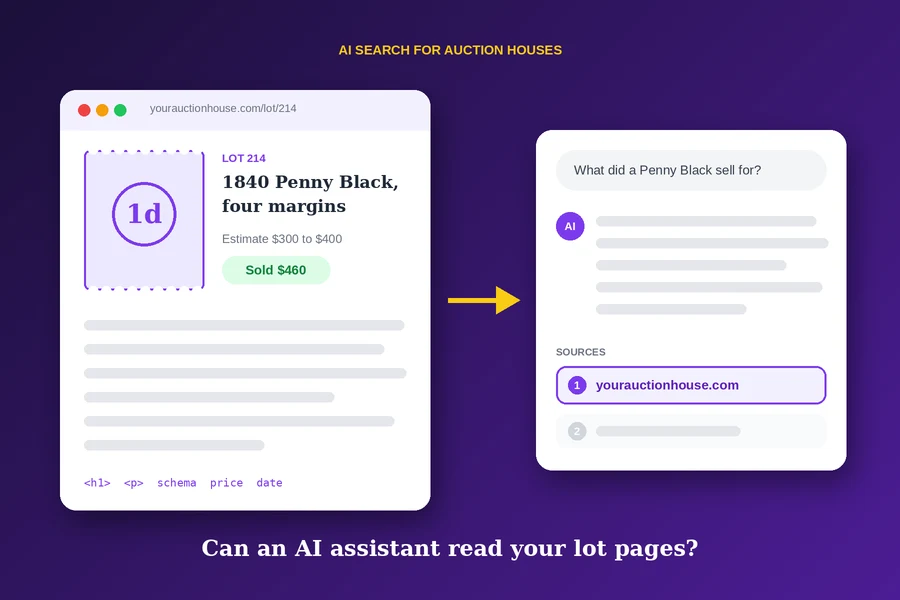
A collector types a question into ChatGPT: what has a mint Penny Black with four margins sold for at auction this year? A widow asks Google where to sell her late husband’s coin collection, and the first thing on the page is an AI summary with three linked sources. An adviser asks Perplexity which auction houses handle mid-century prints in the Midwest.
In each case an answer is assembled from pages that a machine fetched and read. Some auction house wrote the lot description, photographed the piece and recorded the hammer price. Whether that house is the one named and linked in the answer depends on things that have very little to do with the quality of the sale and a great deal to do with how the website is built.
This post is about those things. It is written for auction house owners, not developers, and every claim about how the AI systems behave comes from their own documentation or from published measurements, listed at the end.
How Big Is This, Honestly
Smaller than the hype and more important than the raw number.
SE Ranking’s study of 101,574 websites found that AI platforms accounted for 0.32% of all website traffic in the first four months of 2026, about one visit in 312. That is small. It was 0.02% in 2024, a sixteenfold increase in two years, and ChatGPT sent about three quarters of it, with Gemini, Perplexity, Copilot and Claude sharing the rest.
The larger effect is inside Google. Pew Research Center tracked the browsing of 900 US adults in March 2025 and found that when a Google results page carried an AI summary, people clicked a traditional result in 8% of visits. Without a summary they clicked in 15%. Only 1% of visits to a page with a summary produced a click on a link inside the summary, and 26% of those pages ended the browsing session altogether, against 16% for pages without one.
Read those two findings together. Fewer searches end in a click, so each ranking is worth less than it was. The links that do get shown and clicked are the handful an AI answer chose as its sources. For a category where buyers research carefully before spending four or five figures, being one of those sources is the new first page.
How an AI Answer Gets Built
There are two routes, and an auction site needs to work for both.
The index route. Each assistant has a crawler that builds a search index in advance. OpenAI’s is OAI-SearchBot, Perplexity’s is PerplexityBot, Anthropic’s is Claude-SearchBot. Google’s AI Overviews and AI Mode use the ordinary Google index built by Googlebot. Google describes a technique it calls query fan-out: the model issues a set of related searches at once, on subtopics of the question, and assembles the answer from what comes back. A question about selling a coin collection may fan out into searches for coin auction houses, consignment terms, recent prices for specific coins and seller commission rates. Each of those is a chance for a specific, well-built page to be picked up.
The live fetch route. When a question needs a page read on the spot, the assistant sends a fetcher on the user’s behalf: ChatGPT-User, Perplexity-User, Claude-User. These read one page, right now, and hand the text to the model.
Separate from both are the training crawlers, GPTBot and ClaudeBot, which collect text for future models. They matter for a different decision, covered below.
Google is explicit that none of this needs a new discipline. Its documentation says there are no additional requirements to appear in AI Overviews or AI Mode, and its guide to generative AI features says that what the industry calls AEO or GEO is, from Google’s side, still SEO. A page has to be indexed and eligible to show a snippet. The fundamentals it lists are the old ones: crawling allowed in robots.txt and by any CDN or hosting infrastructure, important content available as text, sensible internal links, a good page experience.
So the question for an auction house is not what new trick to add. It is which of the old fundamentals the site quietly fails. On auction websites, four failures come up again and again.
Failure One: The Lot Is Drawn by JavaScript
Open a lot page on your site, turn off JavaScript in the browser, and reload. If the description, the estimate and the image are gone, they are gone for most AI systems too.
Vercel and the technical SEO firm MERJ analyzed crawler traffic across Vercel’s network and published the results in December 2024. GPTBot had made 569 million fetches in a month and Claude’s crawler 370 million. Their finding on rendering was blunt: none of the major AI crawlers rendered JavaScript. The list included GPTBot, OAI-SearchBot, ChatGPT-User, ClaudeBot and PerplexityBot. The crawlers downloaded script files, but did not run them. Google’s Gemini was the exception, because it uses Googlebot’s infrastructure, which does render.
That study is two years old and the crawlers may improve. Nobody should plan a sale calendar around that hope. Many auction websites are a thin page with a bidding widget, an iframe or a marketplace embed that loads the catalog after the page arrives. A person sees 600 lots. A fetcher sees a logo, a menu and an empty box.
The fix is architectural: every lot, sale and results page should arrive as complete HTML, with the title, description, estimate, price and image references in the document itself. The live parts, the current bid and the clock, can load afterwards. This is the main reason the Circuit Auction Website publishes catalog pages as pre-rendered HTML rather than assembling them in the browser.
Failure Two: The Results Disappear
Think about what people actually ask an assistant about auctions. Very few questions are “what is being sold next Thursday”. Most are about value and precedent. What did this sell for? What is mine worth? Who sells this kind of thing, and how well?
The evidence for every one of those answers is a past lot with a hammer price. An archive of prices realized is the most citable thing an auction house owns, and it is the content most often thrown away. Sites delete lot pages when the sale closes, reuse the same URLs for the next sale, put results behind a bidder login, or publish them as a PDF list of lot numbers and prices with no descriptions.
The Vercel analysis has a number that should worry anyone who does this. ChatGPT’s crawlers spent 34.82% of their fetches on pages that returned a 404, and Claude’s 34.16%. Googlebot’s figure was 8.22%. AI systems lean heavily on URLs they learned earlier, and they are far worse than Google at noticing that a page has moved. Every deleted lot page is a dead end for a system that was trying to cite you. We saw the same pattern from the other side during the bot surge on Stamp Circuit, where 83% of requested pages were ones that did not exist.
The rule is simple to state. One lot, one URL, forever. After the sale the page stays public and gains the price, the sale date and a link to similar lots in upcoming sales. The archive is then both the evidence for an AI answer and the best consignment advertisement a house can have, because the person asking what a collection is worth is very often the person about to consign it.
Failure Three: The Crawlers Are Blocked and Nobody Knows
Auction houses rarely decide to block AI search. It happens to them.
The CDN decided. On July 1, 2025 Cloudflare announced that it was changing its default to block AI crawlers unless they pay for access. Whatever one thinks of the principle, the practical result is that a site set up on Cloudflare since then may be turning away the crawlers that build AI search indexes without anyone at the auction house having chosen that. Google’s own checklist includes the line for a reason: crawling must be allowed in robots.txt and by any CDN or hosting infrastructure.
A security setting was left on. A challenge page such as Cloudflare’s Under Attack mode asks every visitor to run JavaScript before the site loads. AI fetchers do not run JavaScript, so they never get past it. We covered this at length in the bot traffic post linked above.
Someone blocked “AI bots” as a group. This is the avoidable one, because the companies document their crawlers separately so that site owners can treat them differently:
| Purpose | OpenAI | Anthropic | Perplexity |
|---|---|---|---|
| Model training | GPTBot | ClaudeBot | none documented |
| Search index | OAI-SearchBot | Claude-SearchBot | PerplexityBot |
| Fetch for a user’s question | ChatGPT-User | Claude-User | Perplexity-User |
OpenAI states that the settings are independent, that a site can allow OAI-SearchBot and disallow GPTBot, and that sites opted out of OAI-SearchBot will not be shown in ChatGPT search answers. Anthropic says that disabling Claude-SearchBot or Claude-User may reduce a site’s visibility in user search results. Perplexity says PerplexityBot is not used to collect content for training foundation models at all.
Whether to allow training crawlers is a fair question on which auction houses will differ. Photographs and descriptions are work product, and a house may not want them in a training set. That is a choice about the top row of the table. The bottom two rows are reach, and reach is what consignors are paying for. Blocking them to make a point about training removes the house from the answer and leaves the marketplaces in it.
One caution for the other direction. The user-request fetchers are less bound by robots.txt than the crawlers are: OpenAI says robots.txt rules may not apply to ChatGPT-User, and Perplexity says Perplexity-User generally ignores them, because a person asked for the page. Anything that must stay private belongs behind a login, not behind a robots.txt line.
Failure Four: The Catalog Lives on Someone Else’s Domain
If the lots are listed on a marketplace and the house’s own website links out to them, or embeds them, then the page that carries the description and the price is the marketplace’s page. The marketplace gets indexed, cited and linked. The next question the collector asks is answered there too, alongside every competing house in the category.
This is the search version of the argument we made in who owns the auction marketplaces: the operator, not the auction house, sets the rules. That includes which crawlers are admitted and whether a results page survives the sale. Listing on a marketplace for reach is a reasonable decision. Having the marketplace hold the only readable copy of your catalog is a different one, and it is the difference between a white label site on your own domain and a storefront inside someone else’s.
What Does Not Matter as Much as You Have Been Told
A fair amount of money is being charged for things the AI companies themselves say are not needed.
llms.txt. A proposed text file that summarizes a site for language models. Google’s guide says that Google Search does not use it and that creating one will neither harm nor help visibility there. John Mueller of Google said the same in July 2026: “Google doesn’t use llms.txt.” An Ahrefs study of server logs from 137,000 domains, reported by PPC Land, found that 97% of llms.txt files received no requests at all in May 2026, and that among the requests that did arrive, SEO audit tools were the largest identified group at 21.7%, while AI retrieval bots made up 1.1%. We publish one on our own site and on the sites we build because it takes minutes and may become useful to agents later. It is a courtesy, not a strategy, and nobody should pay a monthly fee for it.
Special AI markup. Google says there is no special schema.org structured data to add for AI features and that structured data is not required for generative AI search. It does recommend keeping ordinary structured data, because it supports rich results, and it insists that the markup match the visible text of the page. For an auction house that means product, event and FAQ markup generated from the same catalog record that fills the page, so the two cannot drift apart. Useful, worth having, not magic.
Rewriting everything “for AI”. Google’s guide says that breaking content into chunks or rewriting it for AI systems is unnecessary, and that manufacturing pages to match fan-out queries falls under its spam policy on scaled content abuse. A lot description written by a specialist who knows the material, with the catalog references, condition and provenance a collector would ask about, is already the best input an answer engine can get. That is also the argument for careful AI-assisted cataloging rather than volume for its own sake.
A Seven-Point Check You Can Run This Week
- The JavaScript test. Disable JavaScript in your browser and load a lot page, a sale page and a past result. Everything that matters should still be there as text.
- The old link test. Take ten lot URLs from a sale that closed two years ago, from old emails or newsletters. Count how many still load and show the price.
- The robots.txt read. Open yoursite.com/robots.txt. Look for blanket rules against AI user agents, and make sure OAI-SearchBot, ChatGPT-User, PerplexityBot, Perplexity-User, Claude-SearchBot and Claude-User are not disallowed.
- The CDN check. If the site is behind Cloudflare or a similar service, ask whoever manages it whether AI crawlers are blocked by default and whether any challenge mode is on. Ask for the answer in writing.
- The Google settings. In Search Console, confirm the important pages are indexed and that no nosnippet or max-snippet rules are limiting what can be shown. Google’s guide also says a site must be included in the generative AI features setting in Search Console to be eligible, so check that it is.
- The text check. Descriptions inside images, flipbook catalogs and PDF-only results are invisible or close to it. The catalog should exist as HTML pages, with the PDF as an extra.
- The measurement. Look at referrals from chatgpt.com, perplexity.ai, gemini.google.com, copilot.microsoft.com and claude.ai in your analytics, and at AI crawler requests in your logs. Then ask the assistants the questions your consignors would ask and see who is cited.
Few auction sites pass all seven on the first try. None of the fixes involves writing differently. They are all about whether the site lets its existing work be read.
What This Means When You Choose a Platform
Auction software is usually bought for the back office and the bidding screen, and the public website is whatever came with it. That made sense when the website was a brochure. It makes less sense when the website is the only part of the system that a search engine or an assistant ever sees.
Five questions cover it.
- Are lot, sale and results pages delivered as complete HTML, or built in the browser?
- Do lot URLs stay live and public after the sale, with the price added?
- Which crawlers are allowed, who decides, and can I see the rules?
- Is the catalog on my domain or on yours?
- Is the structured data generated from the catalog record, or added by hand?
Our own answers are on the auction website SEO and AI search page. The short version: complete HTML for every page, permanent lot URLs with results published from the system that ran the bidding, verified search and AI crawlers allowed in normal operation and under load, your domain, and markup generated with every page.
The Point
The shift to AI answers has not changed what makes an auction house worth citing. Expert descriptions, honest estimates and a long public record of what things sold for were the assets before and they are the assets now. What has changed is the cost of hiding them. A catalog that needs a browser to assemble, results that vanish with the sale and a firewall that turns away the reader were survivable when Google sent ten blue links. They are not survivable when the answer names three sources and most people stop there.
About Circuit Auction
Circuit Auction is a turnkey platform for professional auction houses: the back office, the live bidding app and the Circuit Auction Website, a fast, secure auction site on your own domain and design that search engines and AI assistants can read in full. Houses that want to start on an existing site can use the WordPress auction plugin and move up at any time.
Want to see how your current lot pages look to an AI crawler? Book a demo and we will run the seven checks on your site while you watch.
Sources (checked November 17, 2026): Google Search Central: AI features and your website, Google Search Central: Optimizing your website for generative AI features on Google Search, OpenAI: Overview of OpenAI crawlers, Perplexity: Perplexity crawlers, Anthropic: Does Anthropic crawl data from the web, and how can site owners block the crawler?, Vercel and MERJ: The rise of the AI crawler (December 17, 2024), Pew Research Center: Google users are less likely to click on links when an AI summary appears in the results (July 22, 2025), SE Ranking: AI traffic research study (June 18, 2026), Cloudflare: Content Independence Day (July 1, 2025), Search Engine Journal: Google’s John Mueller on llms.txt (July 6, 2026), PPC Land: llms.txt adoption rises but 97% of files get zero AI requests, reporting the Ahrefs study (July 2, 2026). The Pew figures describe US users in March 2025 and the Vercel figures describe crawler behavior in late 2024; both may have moved since.